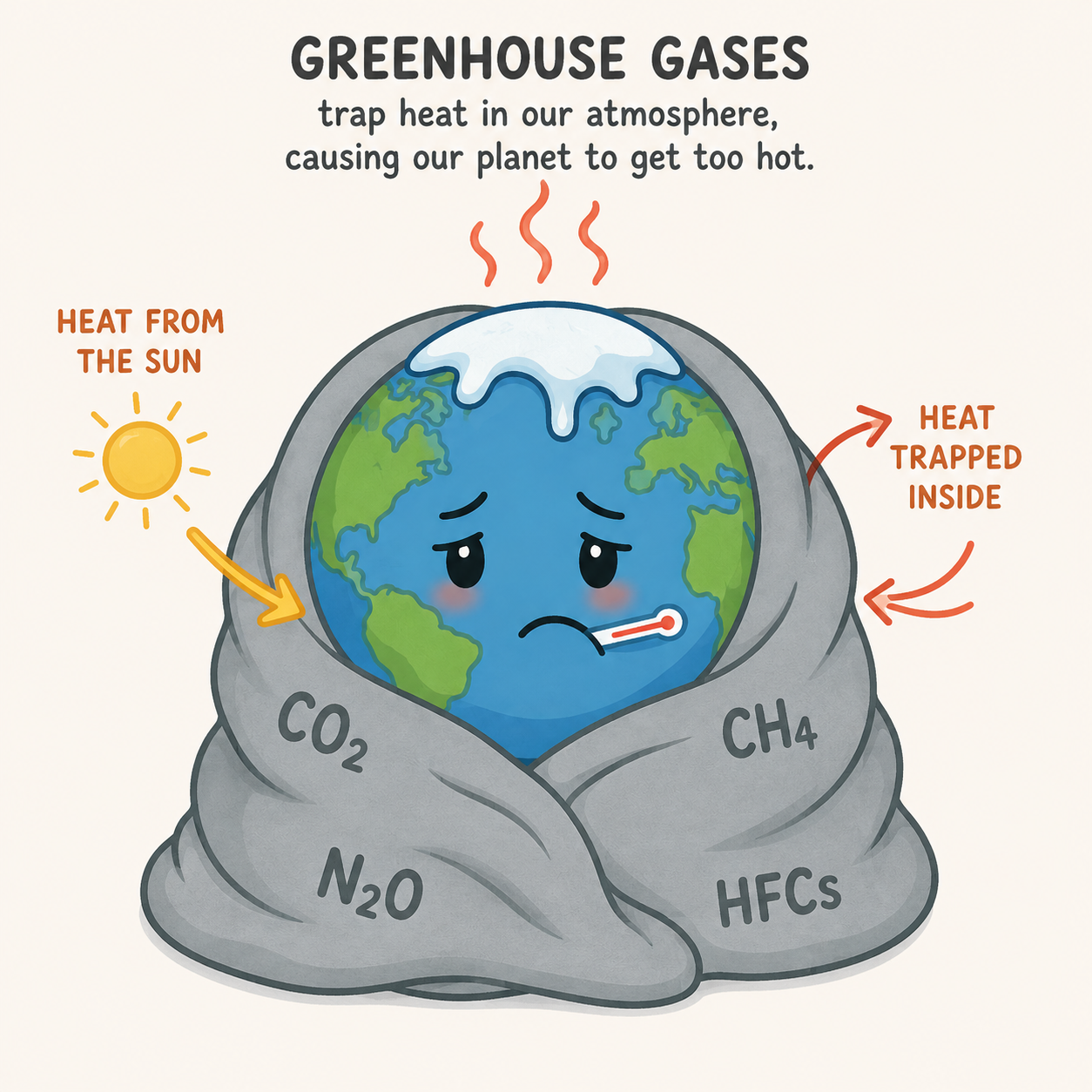
Climate Change Meeting of the Minds
How Is Climate Energy Hitting You?
1Climatologist, Economist
2Physicist
The Meeting of the Minds took place in West Chester, PA, in August 2026.
Taking the Temperature of Climate Change: Bend Over
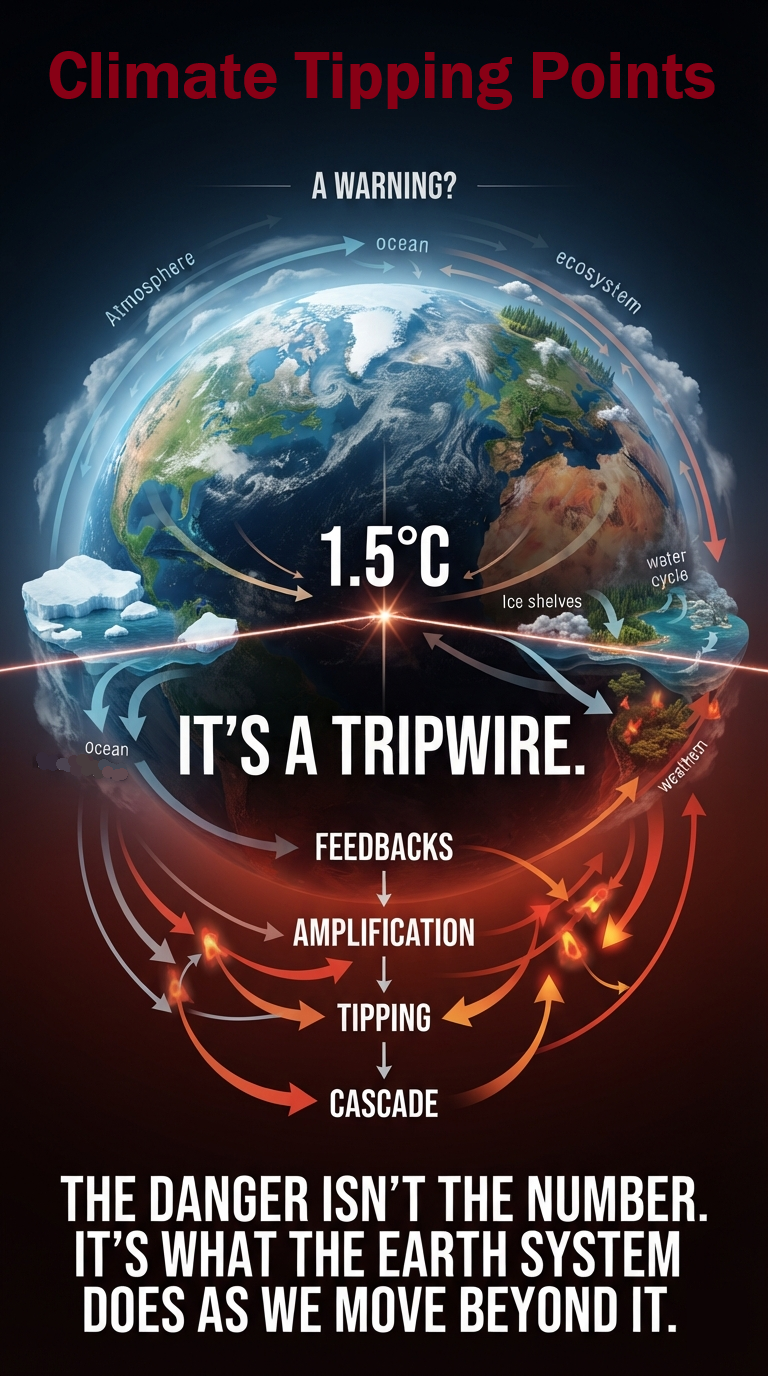
Much of the world is focused on 1.5°C.
One reason the public has become so focused on this number is its simplicity. A 1.5°C (2.7°F) increase sounds like a straightforward, easily understood concept. It also doesn’t sound particularly frightening. After all, what’s the big deal about a couple of degrees of warming? Some people even portray it as potentially beneficial.
Scientists take a very different view.
There are many ways to look at climate change. At the micro level, millions of individual feedbacks are operating throughout the Earth system—between the atmosphere, oceans, ice, land, ecosystems, and human systems. At the macro level, all of those interactions combine to form a single, interconnected climate system.
The critical question is not simply how much the planet warms, but what happens as warming changes the system itself.
Understanding how these feedbacks interact—and, more importantly, how they amplify one another—is at the bleeding edge of climate science. The climate system is not a simple thermostat in which each additional degree produces a proportionally larger but otherwise predictable effect. It is a complex, nonlinear system capable of crossing thresholds and shifting into fundamentally different states.
That is why 1.5°C matters.
The 1.5°C threshold identified in the Paris Agreement—and the roughly 2°C level generally regarded as an even more dangerous boundary—is not important because the difference between 1.4°C and 1.5°C is somehow magical. These numbers matter because increasing global temperatures raise the probability of triggering major climate tipping points.
And once tipping points begin to activate, the question of whether warming ultimately reaches 2°C, 3°C, or even 4–7°C becomes much less relevant for two fundamental reasons:
First, tipping points can initiate self-reinforcing feedbacks that continue driving change even after the original forcing changes.
Second, the impacts do not necessarily increase gradually with temperature. They can accelerate, compound, and cascade as interconnected systems begin to destabilize.
In other words, 1.5°C is not a destination. It is not merely a warning sign or an alarm. It is a tripwire.
A warning sign tells you that danger is ahead. An alarm tells you that danger may already be present. A tripwire is different: it marks a threshold at which crossing the line can trigger a chain of events that becomes increasingly difficult to control or reverse.
That is the critical distinction that can be lost when climate change is reduced to a single temperature number.
The real danger lies not in the number itself, but in what the Earth system is doing as we move beyond it.
We are not simply adding another fraction of a degree to a static planet. We are increasing the energy entering a dynamic, interconnected system—and that additional energy is altering the very processes that determine how the system responds.
The question, therefore, is not simply, “How many degrees warmer will Earth become?”
The more important question is:
“What happens as we cross the tripwires?”
Tripping Tipping Points
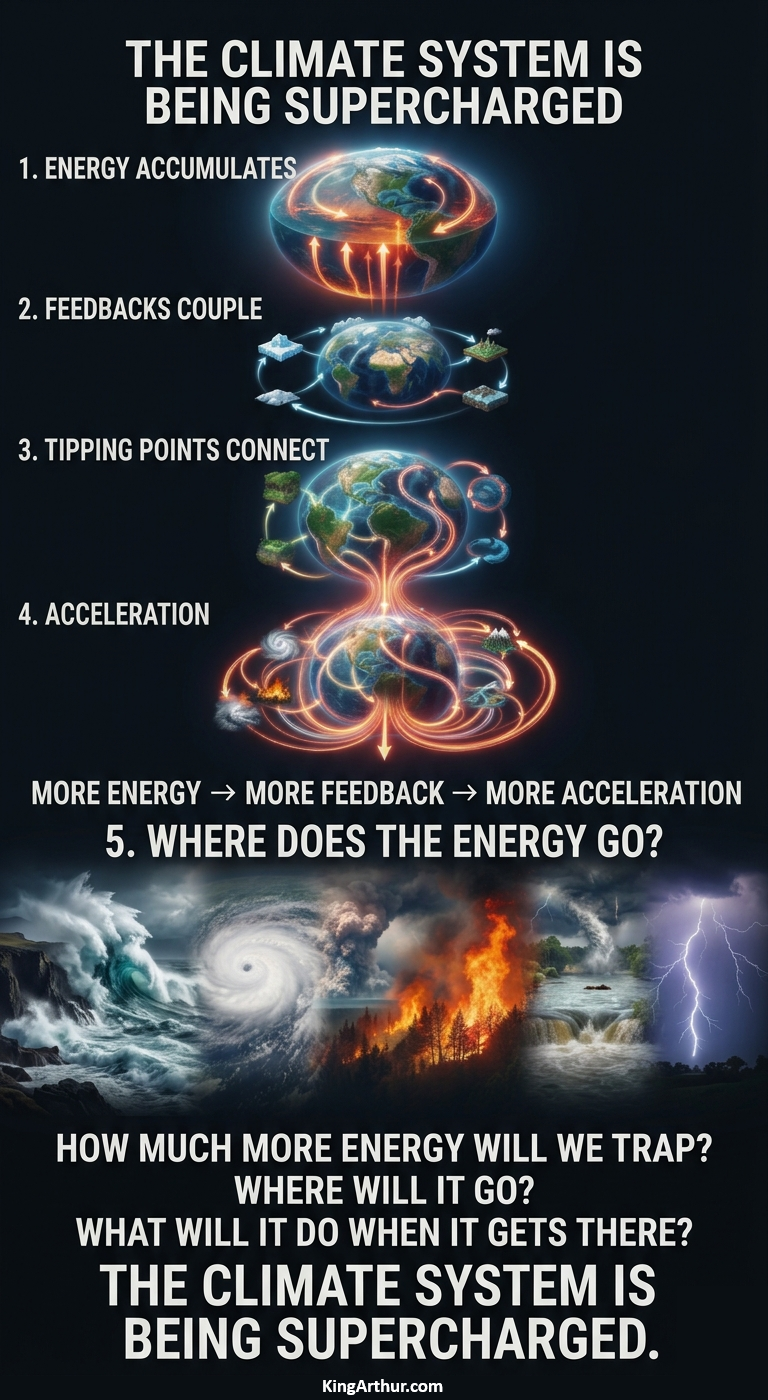
Two interconnected processes are particularly important in determining how the climate system approaches and crosses these tripwires: 1) the enormous amount of excess energy stored in the oceans, and 2) the activation and coupling of tipping points that can amplify feedbacks and accelerate climate change.
The first determines how much energy is already loaded into the system. The second determines how that energy can be redistributed, amplified, and transferred through interconnected components of the Earth system.
1. The Ocean Holds Most of the Energy Imbalance
The ocean holds most of the excess energy accumulating in the climate system. A deep-ocean study has revealed that even the deepest layers of the ocean are warming at a measurable rate.
The oceans absorb and store more than 90% of the excess heat trapped by greenhouse gases. In 2025, a tiny increase—one-tenth of a degree—was observed. That seemingly insignificant change represents an enormous amount of additional stored thermal energy. This represents an amount of stored thermal energy roughly equivalent to a 2°C increase in the atmosphere and surface system.
If the accumulated ocean heat were distributed across land surfaces, it would equate to an estimated 35°C increase in land temperatures—a level that would make much of the planet uninhabitable.
This illustrates how the oceans have been masking the full extent of the Earth’s energy imbalance, acting as a temporary thermal buffer while simultaneously undergoing changes of their own, including increased stratification, circulation changes, and ecosystem disruption.
The entire Pacific Ocean is running approximately 1.6°C above its long-term average—roughly six standard deviations above the mean. In climate science, deviations of this magnitude are virtually off the charts, underscoring just how far outside what we would consider normal variability the climate system has moved.
2. Tipping Points Take Over the Coupling and Acceleration
Tipping points can fundamentally change how the climate system responds by coupling positive and negative feedbacks across multiple components of the Earth system.
The overriding concern for humanity should not simply be the average surface temperature. It should be how the millions of interconnected feedbacks within the climate system will respond.
We have a pretty good understanding of some of these feedbacks. For many others, we don’t.
One of the simplest examples is the albedo effect.
The physics of albedo is straightforward: bright, reflective surfaces send a portion of incoming solar energy back into space, while darker surfaces absorb more of it. Less ice means more exposed dark surfaces, more absorbed energy, and therefore more warming.
But the system quickly becomes much more complicated.
How does changing albedo affect cloud formation, particularly over the tropics? And what happens to the climate if those clouds increase—or decrease?
Low clouds are especially important because they can reflect substantial amounts of incoming sunlight back into space. If tropical low clouds diminish, the ocean could absorb significantly more solar energy, accelerating warming.
This is where the bleeding edge of climate science begins.
Clouds are arguably the largest remaining uncertainty in our understanding of climate sensitivity. They can reflect incoming solar radiation, producing a cooling effect, while high, thin clouds can allow incoming sunlight through while trapping outgoing heat.
See: Low-Level Cloud Feedback: The Mega-Multiplier — An Additional 1.5°C to 2°C
Which effect dominates—and how that balance changes as the planet warms—is one of the great unanswered questions in climate science.
Our expectation is that the climate system could eventually approach a new equilibrium around +4°C above the preindustrial baseline, perhaps this century.
The important point is that climate change is not a simple linear equation.
It is a massively interconnected system in which a change in one component can alter another, which then feeds back into the first.
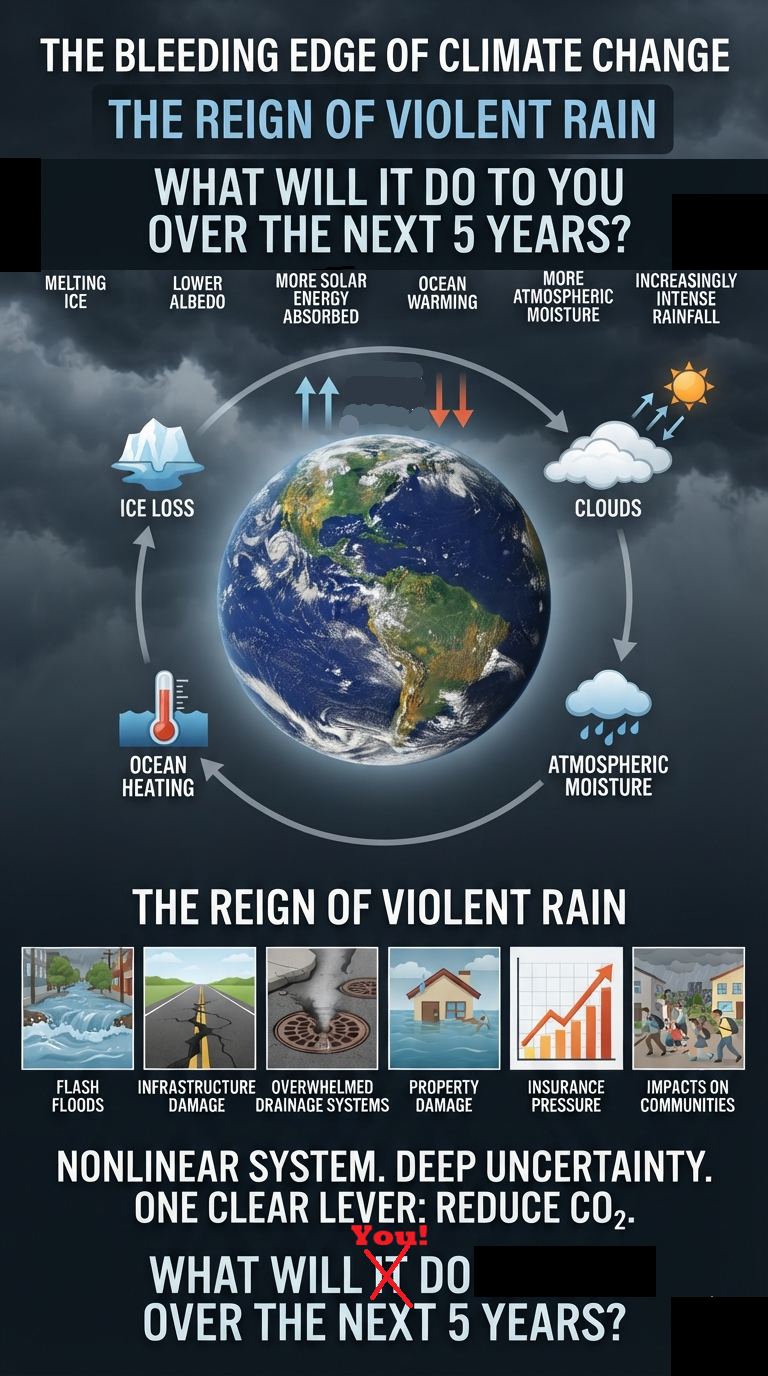
Ice affects albedo. Albedo affects heating. Heating affects clouds. Clouds affect radiation. Radiation affects ocean temperatures. Ocean temperatures affect evaporation and atmospheric moisture. And the cycle continues.
Conclusion
What matters most for human habitability is not simply the temperature we measure at the surface. It is the amount of energy remaining in the climate system and how that energy is redistributed.
If the temperature “only” rises 2°C while energy accumulation continues, the surface temperature becomes much less informative by itself. What becomes increasingly urgent is how that additional energy—measured in joules—is redistributed to your location.
The most obvious example is the supercharged water cycle.
For every 1°C increase in temperature, air can hold approximately 7% more water vapor. The atmosphere doesn’t care about the global average temperature. Many places can experience temperatures 10°C above their local average. That creates the potential for dramatically greater atmospheric moisture and, consequently, more intense rain, hail, and snow events when that moisture is released.
And indeed, we are seeing extreme flood events occurring with increasing frequency, including events described as having return periods of hundreds of years. Hail has also become one of the largest sources of insurance claims affecting homes, automobiles, and agriculture.
While the long-term equilibrium matters, there is a much more immediate question.
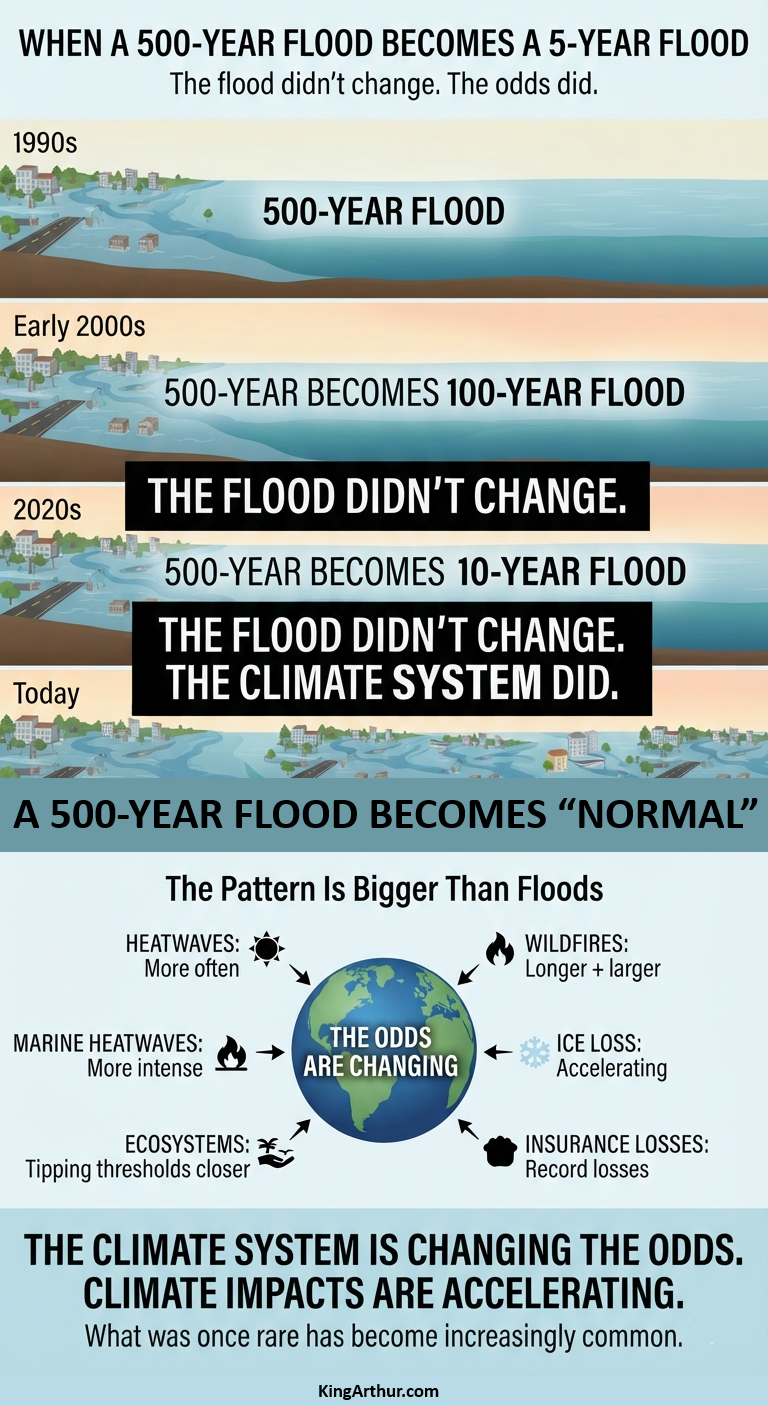
What happens to you over the next five years?
We are already seeing rainfall becoming more intense and, in many places, more destructive—violent. A warmer atmosphere can hold more water vapor, increasing the potential for extreme precipitation. The question isn’t simply how hot the planet might become over the next 50 years.
The more immediate question is:
What is the violent rain going to do to your home, your community, your infrastructure, your insurance—and you—over the next five years?
That is where climate change stops being a distant projection and starts becoming a personal reality.
Welcome to the future. Climate change is accelerating—and the acceleration itself is accelerating.
As tipping points become increasingly coupled and reinforce one another, the amount of energy moving through the climate system is accelerating—and the rate of acceleration itself is increasing.
At this point, the question is no longer simply, “How many degrees warmer will the planet become?”
The more important questions are: How much additional energy are we going to continue trapping? Where is all that energy going? And what will it do when it gets there?
We are already beginning to see the answers—in floods, heatwaves, flash droughts, wildfires, hailstorms, extreme precipitation, and increasingly volatile swings between opposing extremes.
These are not separate problems.
They are different manifestations of an increasingly energized climate system.
The planet does not experience climate change as a number on a thermometer.
It experiences it as energy moving through the system.
And that energy has to go somewhere.
The climate system is being supercharged.
The question is no longer whether that energy will affect us.
The question is where it will hit—and what it will do when it gets there.
Postscript: Where Does All That Energy Go?
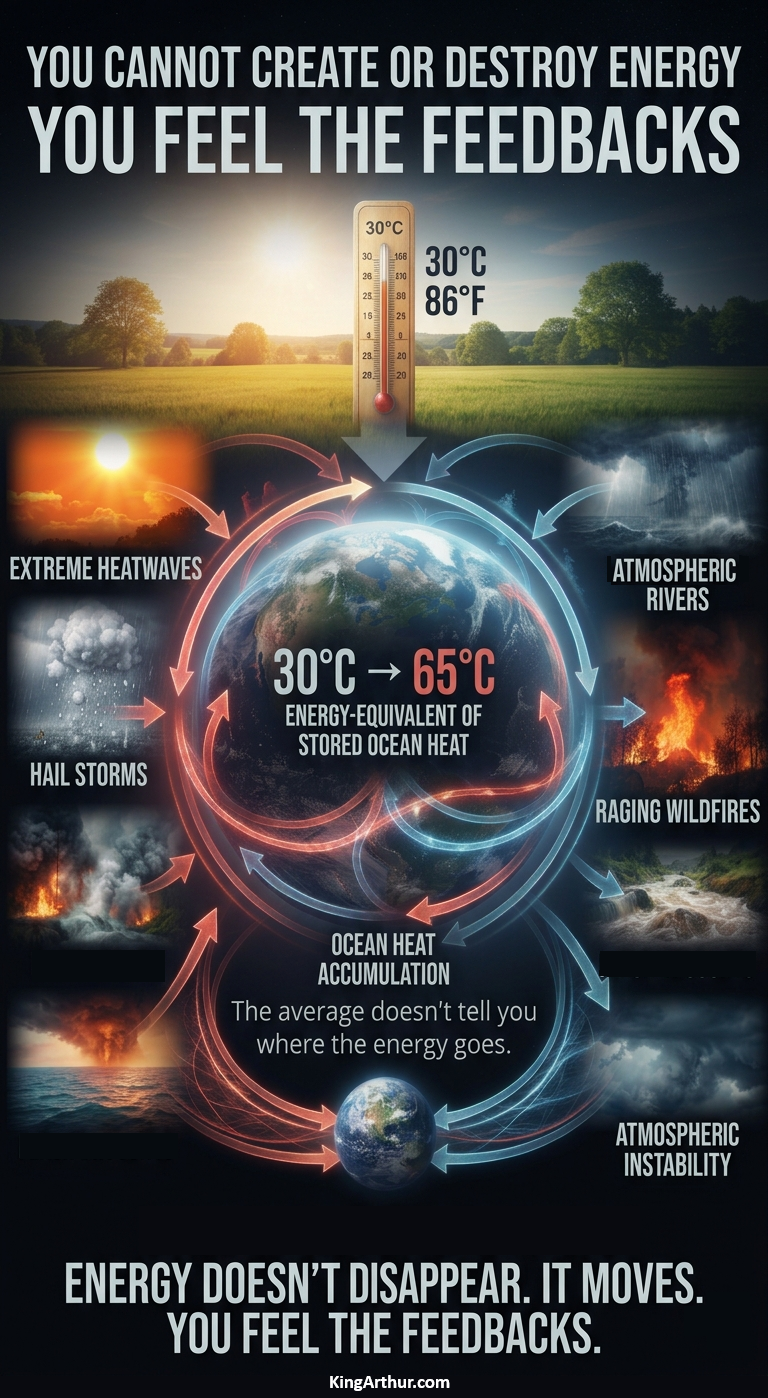
Q: I don’t quite understand part of the paper. What does a “35 degree increase” in temperature mean? Where I live, a summer day can be around 30 degrees Celsius. Would this mean a summer day at around 65 degrees? (30+35=65). Wouldn’t that be lethal?
A: Good question. The answer is yes—and no. That’s actually part of the point of the paper.
A 65°C temperature at your location would obviously be lethal. But the 35°C figure is an energy-equivalent thought experiment, not a prediction that your local summer temperature would simply go from 30°C to 65°C.
The bigger problem with using average temperatures is just that—they are averages. An average of 65°C across a large area could mean one location is 30°C, another is 40°C, and another is far beyond either. The distribution of that energy matters far more to human habitability than the average itself.
And that’s where I don’t expect all of the already stored energy to behave “on average.” I don’t know exactly how that energy will hit you. It could manifest as violent rainfall, hail, heatwaves, wildfires, flash droughts, or any number of other energy transfers we haven’t fully anticipated.
But as long as that energy remains trapped in the Earth system, it doesn’t simply disappear. It continues moving through the system and interacting with everything else. You cannot create or destroy energy—you can only experience its feedbacks.
And yes, we would have to adapt. If conditions outside became routinely lethal, people might increasingly move underground or into heavily climate-controlled environments to survive.
In any event, an average of 65°C would be pretty close to hell—whether you’re experiencing it alive or studying it after the fact. 😏
How Is Climate Energy Hitting You?
Backyard Experiments
How Is the Climate Energy Hitting You? is a collection of backyard experiments conducted in conjunction with you—the reader. The goal is simple: to look at how the increased energy in the climate system is showing up in our everyday lives.Is it becoming more extreme, more frequent, and more persistent? Are the changes becoming stranger—or even disturbing?
How Is Climate Energy Hitting You?
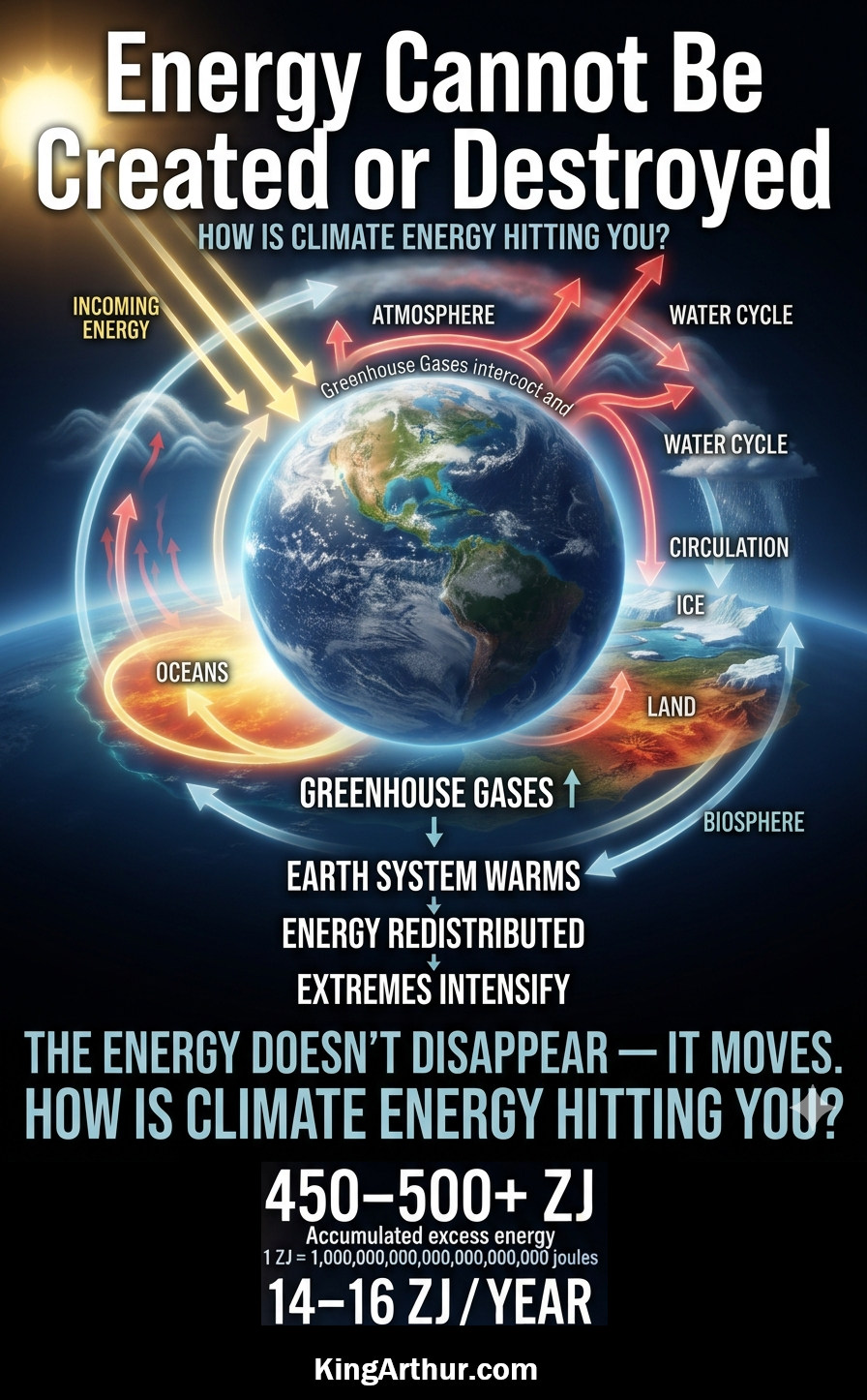
🌎⚡ ENERGY CANNOT BE CREATED OR DESTROYED
So where does all that extra energy in the climate system go?
It doesn’t disappear.
It moves. 🌊💨💧🌀🧊🌱
The oceans absorb enormous amounts of heat. The atmosphere transports energy and moisture. Evaporation moves latent heat. Storms redistribute energy through intense precipitation. Ocean currents carry heat across the planet. Ice melts. Land heats and dries. Ecosystems respond.
And the greenhouse effect changes the planet’s energy balance—leaving more energy within the Earth system before it can ultimately escape to space.
450–500+ ZJ
🌡️ Accumulated excess energy
14–16 ZJ / YEAR
⚡ Approximate additional energy absorbed annually
The important question isn’t simply “How much has the temperature risen?”
It is:
HOW IS CLIMATE ENERGY HITTING YOU?
Weather. Water. Heat. Flooding. Drought. Ecosystems. Agriculture. Infrastructure. Risk.
The energy doesn’t disappear.
THE ENERGY DOESN’T DISAPPEAR — IT MOVES.
🌎⚡ How is climate energy hitting you?
Backyard Experiments
How Is the Climate Energy Hitting You? is a collection of backyard experiments conducted in conjunction with you—the reader. The goal is simple: to look at how the increased energy in the climate system is showing up in our everyday lives.Is it becoming more extreme, more frequent, and more persistent? Are the changes becoming stranger—or even disturbing?
- Low-Level Cloud Feedback: The Mega-Multiplier — An Additional 1.5°C to 2°C
- The First Law of Thermodynamics: Energy Cannot Be Created or Destroyed
- Planetary Teleconnections: Energy and Chaos Theory
- Why Hasn’t There Been a Hurricane? Climate Energy Is Being Redistributed
- Most Powerful Feedback: Water Vapor — the Greatest Climate Amplifier
- The One-Two Punch of Doubling Feedbacks
- Feedback Feedback
- Hottest Summer Ever: Those Hot Summer Nights Jerk-Behavior
- The Times They Are a-Changing: Climate Change, Acceleration, and Inertia 4–7°C
- Philadelphia and Southeastern PA: Heatwaves, Severe Storms, Flash Floods, Flash Droughts, Extreme Winds, Microbursts, Tornadoes
- Barrier-Islands From the Jersey Shore to the Outer Banks
- The I-95 Corridor: Severe Storms, an Expanding “Tornado Alley,” Straight-Line Winds, and the Urban Heat Island
- Pennsylvania: When the Levee Breaks — Crying Won’t Help You, Praying Won’t Do You No Good
- Chester County, It’s Shocking: Lightning Strikes Are Surging
- Chester County: Rapid-Fire, Near-Continuous Cloud-to-Cloud Lightning
- West Chester, Pennsylvania: Urban Flooding — Unfortunately, Worms Can't Swim
- West Chester, Pennsylvania: Hydroclimatic Whiplash and Flash Droughts — Unfortunately, Millipedes Can't Swim
- The Backyard Experiments: Hydroclimatic Whiplash, Soil Degradation, Insect Decline, and Ecosystem Collapse
- Coatesville, PA: Hydroclimatic Whiplash — Dying of Thirst in a Flood
- Backyard Megapitfall Traps: A Changing Ecosystem for Frogs, Spiders, and Worms
- Accelerating Seasonal Expansion: Forever Summer
- Phenology: Disruption in Penn’s Sylvania
- The Jersey Shore and Florida Coast: Sea Level Rise, Inverse Barometer Effect, Wind Stress, Flooding, Saltwater Intrusion
- Central England: Five Heatwaves, Official Drought, Record Wildfires, Hydroclimatic Whiplash, and Worst Harvest on Record
- Indiana and New York: When 1-in-1,000-Year Rain Becomes Real-World
- The Grand Canyon Flash Flood Tragedy
- Worldwide Record Heat, Rain, Snow, and Flooding → Walpeup and Hopetoun, Australia; Floridia, Italy; Miami; Joubertina, South Africa; Bridgeport; Philadelphia
- Sudan: Hydroclimatic Whiplash and the Socio-Economic Feedback Loop
- Death Valley: When the Desert’s Extremes Become More Extreme
- Sweden: Heatwaves, Hydroclimatic Whiplash, Forest Decline, Coastal Erosion, and the Northward Spread of Disease
- Planetary Teleconnections: The Pacific El Niño–Atlantic Niña Atmospheric Bridge
- Nicolas Cage's Whole Sinkhole: Coastal Erosion, Property Loss, and the Uninsurable Coast
- Turkey: Water Poor. No Water Pour. Sinkhole Crisis.
- Reservoir Dry Dogs: Climate Change Is Shrinking America’s Water Storage
- California: Wave to Kelvin
- SoCal Coastal Armoring: Sea Level vs. Private Property Rights
The Wildfire & Resilience Series
- Reno, Nevada and Lake Tahoe: Hydroclimatic Whiplash, Flash Droughts, Extreme Winds, Wildfires, and Thermal Stratification
- North Texas: Drought, Wildfire, Evacuation, Water Scarcity, Livestock Liquidation, Crop Failure
- Western U.S. Woodlands Ecosystem Conversion
- California and the Sierras: Hydroclimatic Whiplash, Atmospheric Rivers, Rain-on-Snow, Droughts, Landslides, Wildfires
- California Wildfire Insurance: Who Pays When the Forest Burns?
- National Forests: Wildfire → Glyphosate → Biodiversity Disaster → Monoculture ↺ Feedback
- Penn’s Sylvania: Forest Ecosystem Conversion — Finding the Native Trees
- Indonesia’s Orangutans and the Peatland Carbon Bomb
The Energy That Moves Mountains
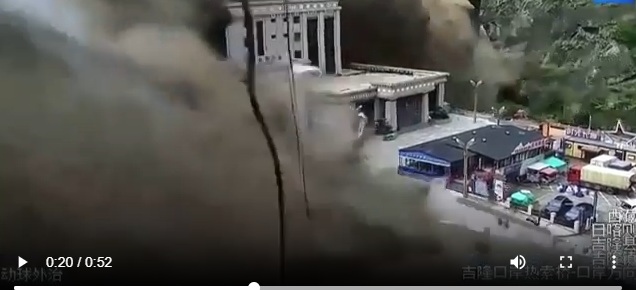
- The Mountains Crumble to the Sea
- Nepal–Tibet: Glacier Loss, Permafrost Collapse, Glacial Lake Outburst Floods, Flash Floods, Mudslides and Avalanches
- The Nepal-Tibet Domino Effect: A Continuous Cascade of Failures
- Nepal-Tibet: Energy Like Wet Concrete
- Nepal-Tibet: Fluidization Physics
- Observe Tipping Points Topple → Climate Change Avalanche
- The Physics of When the Earth Starts Moving
- Greenland: 6,205 Gigatons of Ice Gone—and the Energy Behind It
- Kyrgyzstan Says, “You Cursed Brat. I’m Melting.”
- Swiss Alps: Fare Thee Well?
Easy-to-Read Resources