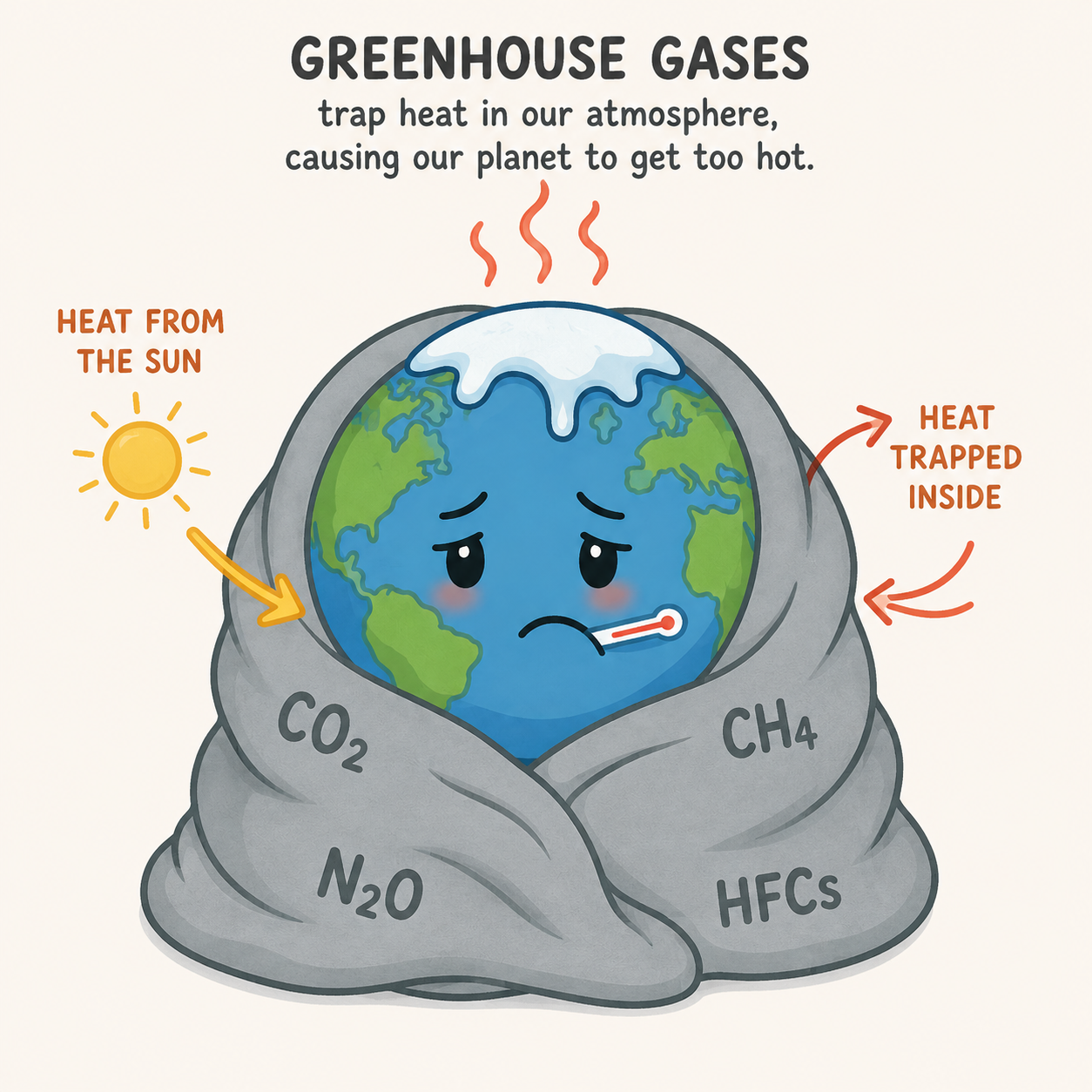
How Is the Climate Energy Hitting You?
Sudden Release • Seismic Climate Event • Outburst Surge
TIPPING POINTS TOPPLE → CLIMATE CHANGE AVALANCHE
A warming cryosphere can destabilize glaciers and mountain slopes, while extreme precipitation supplies additional water to an already unstable system. A single gravitational collapse can then trigger river blockage, dam failure, flash flooding, and a measurable seismic signal.
Seismic Climate Events: When Cryosphere Instability Becomes an Earth-System Hazard
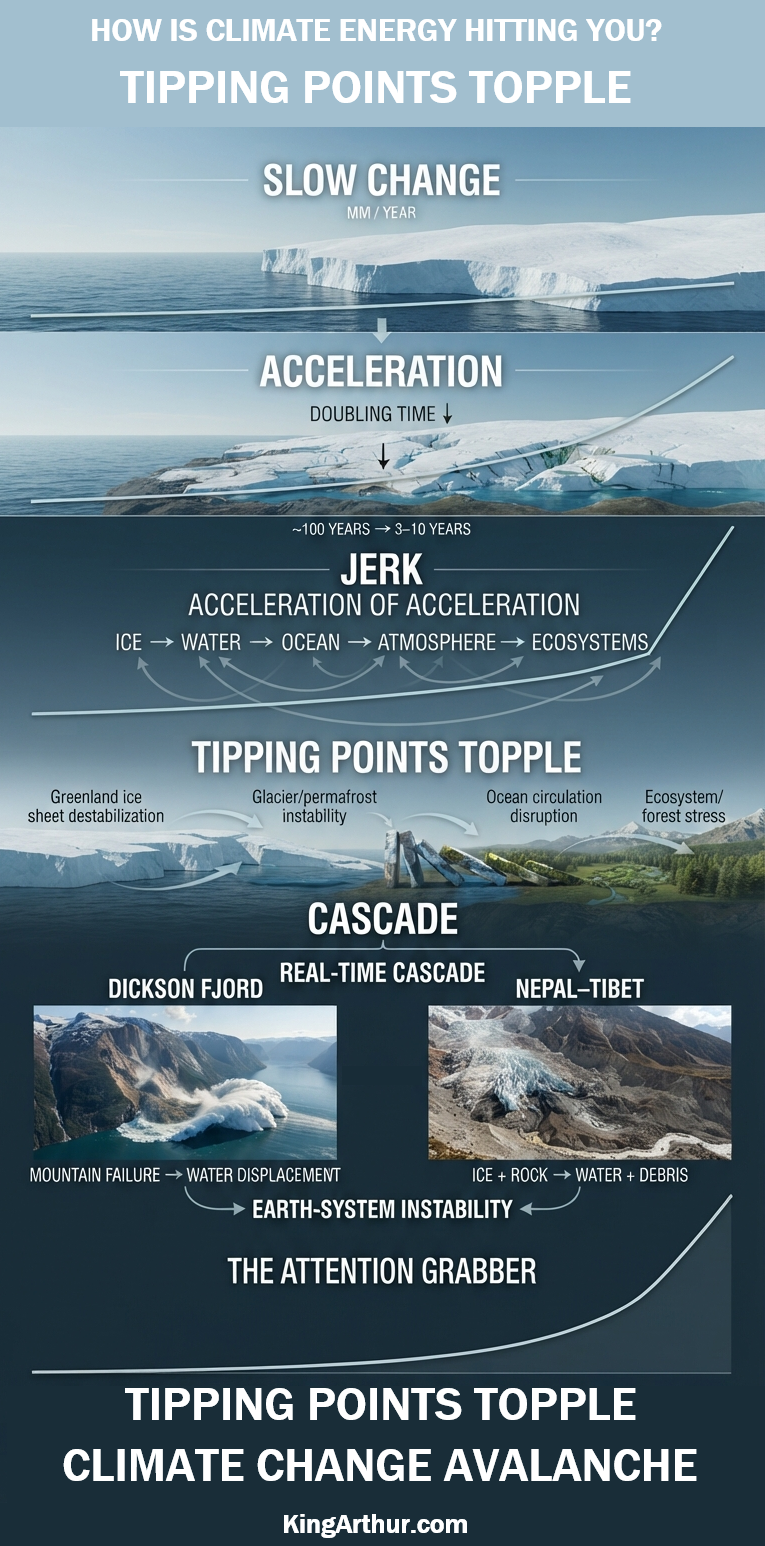
I’ve written quite a bit about “Sudden Sea Level Pulses: How ‘Cork Release’ Events Could Rapidly Reshape Coastlines,” which you might find interesting. I expect we will see several feet of sea-level rise for several years in a row this century.
The big examples in Earth’s past occurred when proglacial lakes suddenly broke through ice dams during the last deglaciation.
When the last Ice Age ended, the Earth experienced “Meltwater Pulse 1A”—a dramatic period roughly 14,500 years ago when sea levels surged upward by about 66 feet in just 500 years. Data from Barbados, Tahiti, and Sunda confirm that the ocean rose at astonishing rates—sometimes more than 40 mm per year. We should expect similar patterns again.
I find sea-level rise very intriguing. However, the problem has always been that it is too “slow” for anybody to care. What’s a couple of millimeters a year?
It took us 10 years to confirm that sea-level rise was doubling every ~100 years—2²-fold on a centennial basis. Since the late 1990s, that doubling time has collapsed to 3–10 years. The collapsing doubling times indicate that SLR acceleration is accelerating at approximately 2⁶-fold on a decadal basis.
Though this jerk/third-derivative behavior is alarming to me, it still doesn’t seem to get people’s attention. This is just one set of climate-impact datasets. Many others show the same rate of acceleration.
Now, we’re crossing 1.5°C in a hurry—and tipping points are beginning to topple.
This is where jerk behavior gets your attention. Cascading tipping points are now observable in real time. As tipping points are crossed, cascading feedbacks begin coupling across the Earth system, causing changes to propagate faster and acceleration itself to accelerate. What once looked like gradual change can suddenly become a rapidly evolving cascade.
Observe Cascading Tipping Points:
Dickson Fjord, Nepal–Tibet, and Suicide Basin
We are fairly confident there are several feet or more of dammed-up meltwater. Jerk behavior puts a much higher probability on jerk-like reactions.
The result isn’t going to be a meter of sea-level rise overnight. It is much more likely to be a serious breach in Greenland that raises sea levels perhaps a foot the first year, two feet the next year, and another foot the following year. Then it may go back to millimeters or inches a year for a few years.
This is one of those feedbacks that is very difficult to comprehend.
Greenland has a lot of dammed-up meltwater. Greenland’s geology is shaped like a bowl. If the ice were to melt in place, most of it would likely stay in the bowl.
But hold on—not so fast.
Sudden-release events on Greenland are not the same thing as slowly melting ice over the last 40 years.
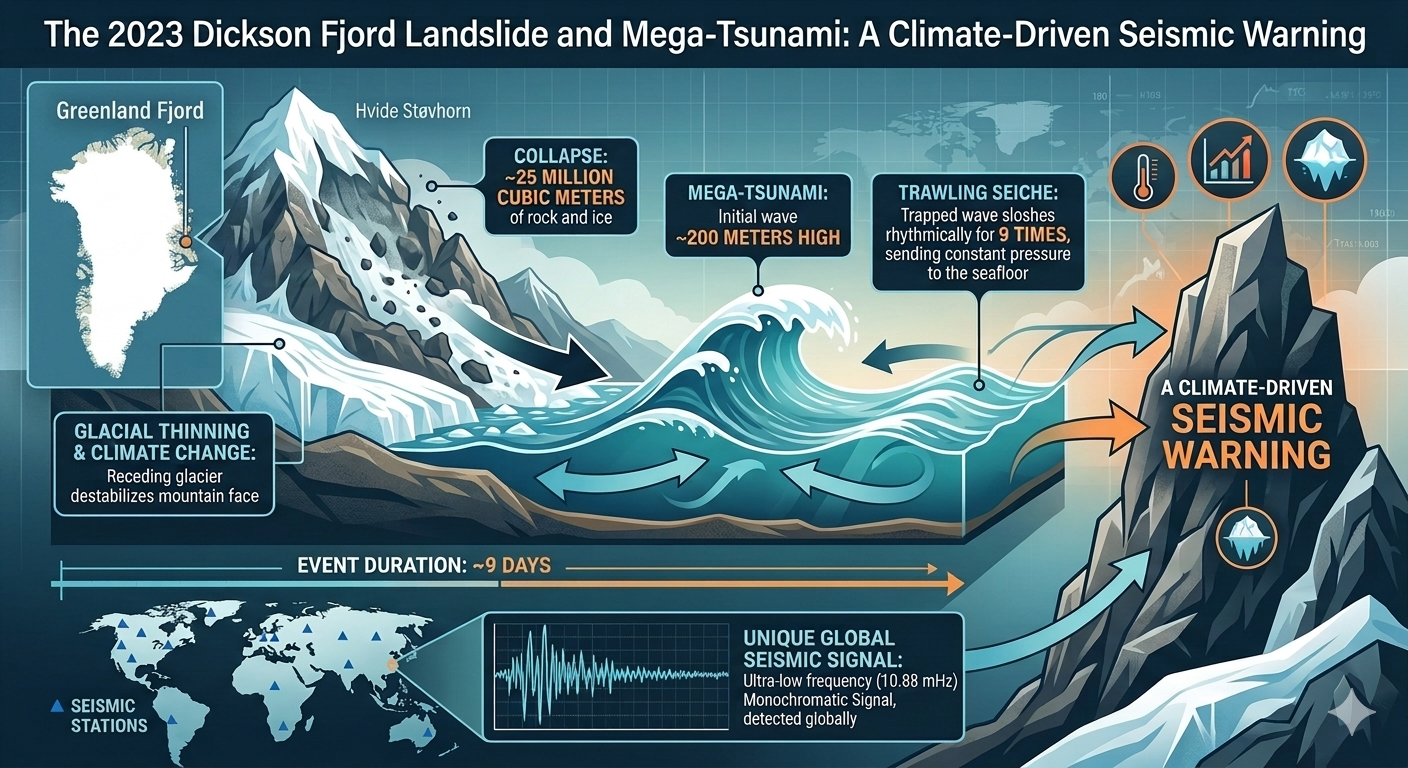
When the geology gives way, as it did in 2023’s Dickson Fjord seiche, the consequences can be extraordinary. That massive rock-and-ice avalanche, involving approximately 25 million cubic meters of material, created a tsunami that registered worldwide as an earthquake for nine days.
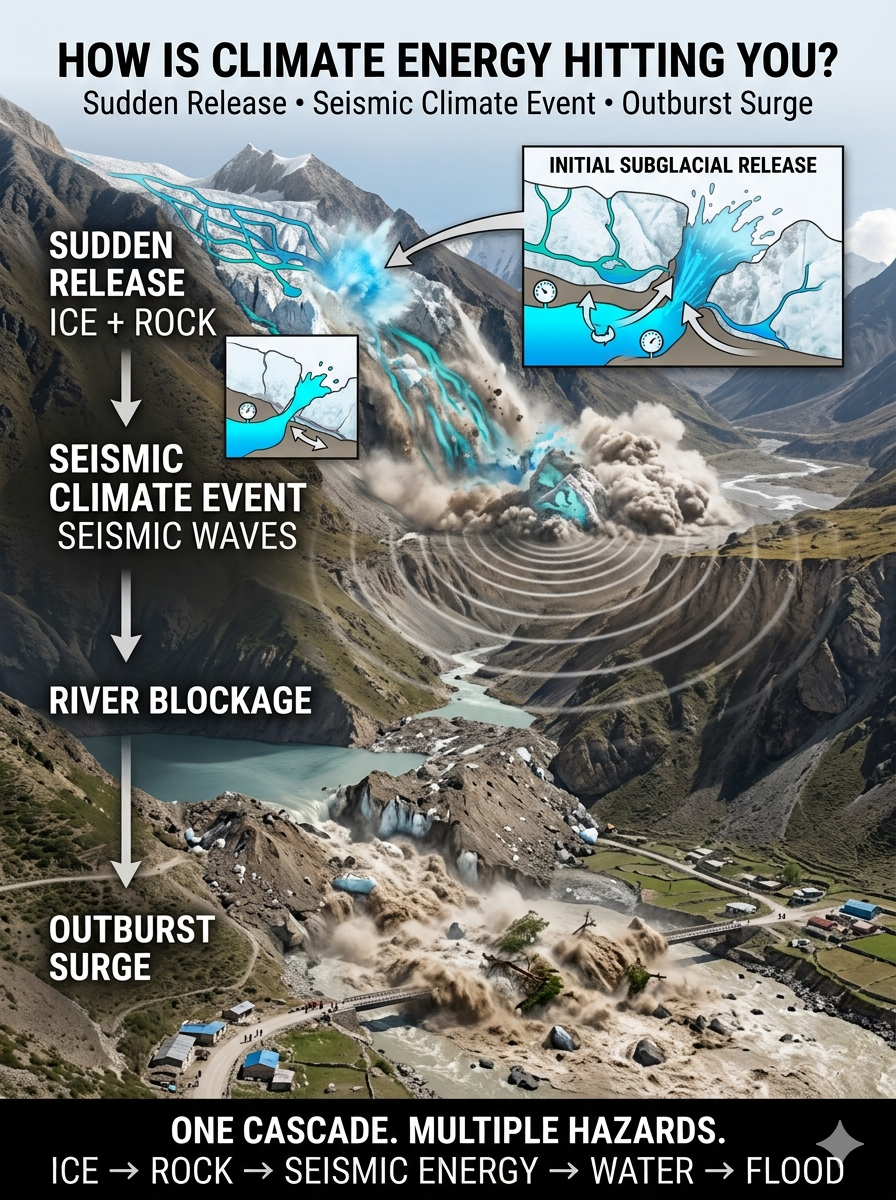
Recently, in Nepal–Tibet, a similar event demonstrated how a massive climate-sensitive mass movement can generate its own seismic signature. Seismic analysis indicates that the recorded shaking was not an earthquake that triggered the landslide. Instead, the enormous ice-and-rock avalanche generated seismic waves equivalent to those associated with a magnitude 4.4–5.2 earthquake.
A massive section of glacier—reported to have detached from an elevation of roughly 5,200 meters (17,000 feet) near Langtang Lirung—broke free and rapidly fragmented as it descended thousands of feet. The enormous mass of ice and rock transformed into a highly mobile mixture of ice, water, sediment, boulders, and trees.
The most likely mechanism is the sudden release of water stored beneath or within the glacier. That water could have dramatically reduced friction beneath the moving mass, allowing the avalanche to accelerate and travel farther than a conventional rockfall or icefall. Rather than behaving like a simple avalanche, the mixture became a rapidly moving debris flow—a slurry of water, ice, sediment, and rock capable of behaving almost like liquid concrete.
The immense mass then crashed into the upper catchment of the Lhende Khola, a river valley along the Nepal–Tibet border. The debris temporarily choked the narrow valley, creating an unstable natural landslide dam.
The Glacial Outburst Surge
Summer glacier melt and seasonal monsoon rainfall continued feeding water into the blocked drainage. As water accumulated behind the debris barrier, pressure increased until the unstable dam failed.
The resulting outburst released a massive surge of water and sediment downstream, producing a destructive wall of water and debris through the connected Himalayan river system.
The significance extends beyond the immediate flood. A warming cryosphere can destabilize glaciers and mountain slopes, while extreme precipitation supplies additional water to an already unstable system. A single gravitational collapse can then trigger river blockage, dam failure, flash flooding, and a measurable seismic signal.
This is the kind of cascading interaction that makes seismic climate events fundamentally different from conventional earthquakes: the climate-sensitive Earth surface itself becomes the source of the seismic energy.
Suicide Basin Glacial Outburst
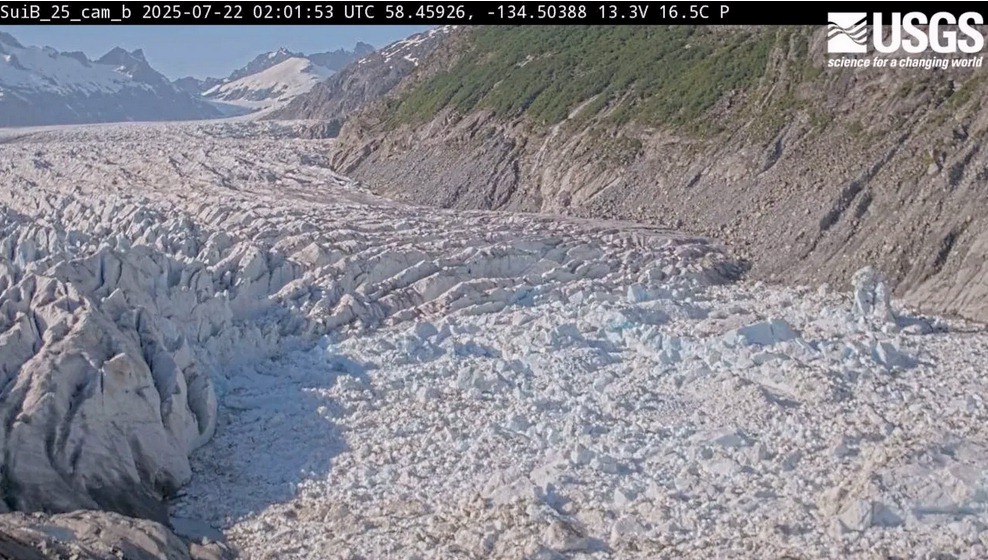
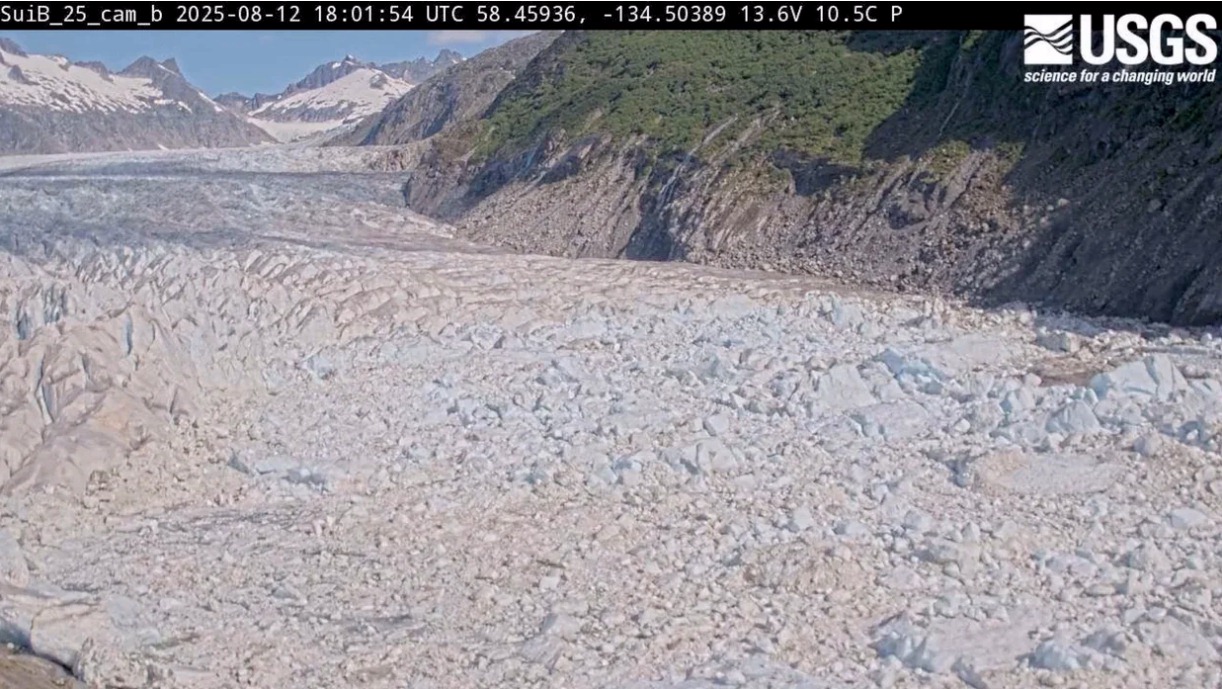
A massive upstream basin of rainwater and snowmelt, dammed by Alaska's Mendenhall Glacier, began releasing in August of 2025, prompting officials to urge residents in parts of Juneau to evacuate ahead of a potentially dangerous surge of floodwater.
A glacial outburst flood occurs when meltwater or rainwater accumulates behind a natural ice dam, creating a substantial reservoir of water under pressure. In the case of the Mendenhall Glacier, snowmelt and rainfall from the upstream basin -- ironically named Suicide Basin -- accumulate behind the glacier, which acts as a solid barrier, trapping the water in depressions known as proglacial lakes or subglacial reservoirs. As the water volume increases, hydrostatic pressure builds against the ice dam. Ice behaves like a viscoelastic material--it can deform slowly under pressure but can fracture if stress exceeds its strength. The weight of the water eventually exceeds the ice's ability to hold it, particularly if crevasses or melt channels weaken the glacier structure. Once the pressure exceeds the strength of the ice or underlying bedrock, cracks propagate rapidly, and water can exploit subglacial channels, forcing its way beneath or through the ice, a process known as hydraulic fracturing. When the dam fails, the water stored in the basin rushes downstream in a high-energy flood, converting potential energy into kinetic energy, generating destructive flow speeds and forces that can erode soil, uproot trees, damage infrastructure, and rapidly raise river levels. Warming temperatures increase surface melt and rainfall, filling these basins faster, while ice thinning and increased meltwater lubricate the glacier bed, reducing friction and making outbursts more likely. In essence, a glacial outburst results from the buildup of pressure from trapped water, ice weakening or cracking, and the sudden release of gravitational energy, producing a high-speed, destructive flood downstream.
Before-and-after shots of Suicide Basin "popping its cork." In the first, a small, fractured section of glacier holds back millions of gallons of water, both behind and beneath it. In the next, it's gone.
The Mendenhall River crested at a record-setting 16.65 feet deep.
See: The Greenland Ice Sheet Outburst Flood and Alaska's Mendenhall Glacier Outburst
Seismic Climate Event
Dickson Fjord and Nepal–Tibet are examples of what can be described as a seismic climate event: climate-driven changes in glaciers, permafrost, snow, and mountain stability can increase the potential for enormous mass movements, which in turn release sufficient mechanical energy to generate measurable seismic signals.
The broader danger is the cascade.
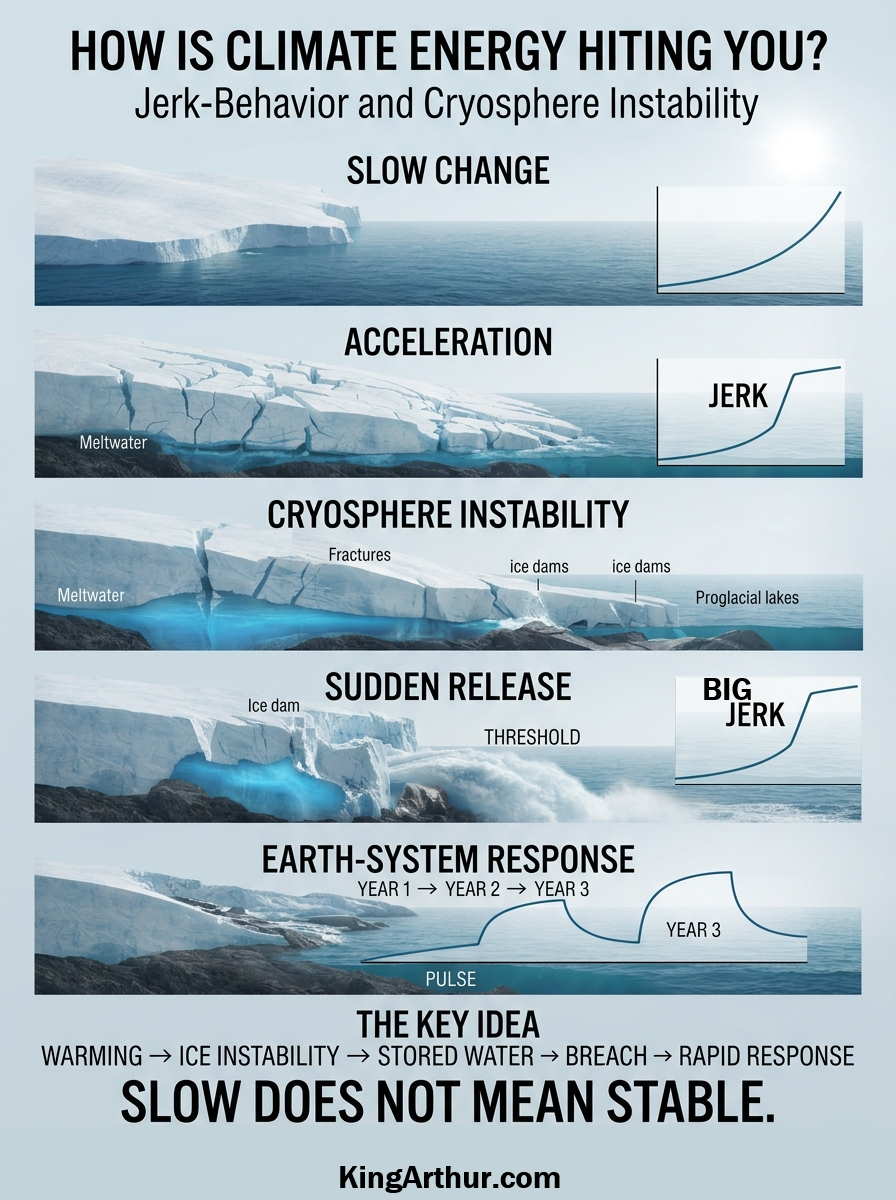
Warming can destabilize the cryosphere. Cryospheric destabilization can trigger massive avalanches and landslides. Those failures can block rivers, generate flash floods and debris flows, and even produce detectable seismic waves.
The resulting disaster is therefore not the product of a single hazard, but of multiple interconnected Earth-system processes interacting in rapid succession.
Greenland gets even more interesting.
That bowl-like shape was caused by the weight of the glacier. As the glacier and meltwater quake into the sea, there will be fairly rapid rebound, and the bowl bottom will rise back up. This rebound is already much faster than earlier predictions.
This all brings Antarctica into the picture, potentially coupling with Greenland. That could be really drastic compared with Greenland alone.
In particular, Sidd said:
“Yes, I saw that. Under-ice hydrology is hard to observe, but there have been efforts with maps made of Greenland and Antarctica—probably incomplete. I still think Greenland will melt largely in place; Antarctica is the big one.”
See: Greenland Melting Is Inevitable
So how much faster the new-normal sea-level rise will be after such an event is quite uncertain—as is how long it will be until the next sudden release.
The important point is that climate change does not necessarily operate as a smooth, linear progression.
Sometimes the Earth system stores energy and mass until a threshold is crossed. Then the response can become abrupt. This is an observable tipping-point cascade, where one threshold crossing can destabilize another system and trigger a rapid sequence of interconnected changes.
That is the fundamental concern with seismic climate events: the climate system is increasingly interacting with a destabilizing cryosphere and a mechanically active landscape, creating the potential for cascading events that are far faster than the gradual changes that initially caused them.
Taking the Temperature of Climate Change: How Is Climate Energy Hitting You?
- The Mountains Crumble to the Sea
- Nepal–Tibet: Glacier Loss, Permafrost Collapse, Glacial Lake Outburst Floods, Flash Floods, Mudslides and Avalanches
- The Physics of When the Earth Starts Moving
Easy-to-Read Resources