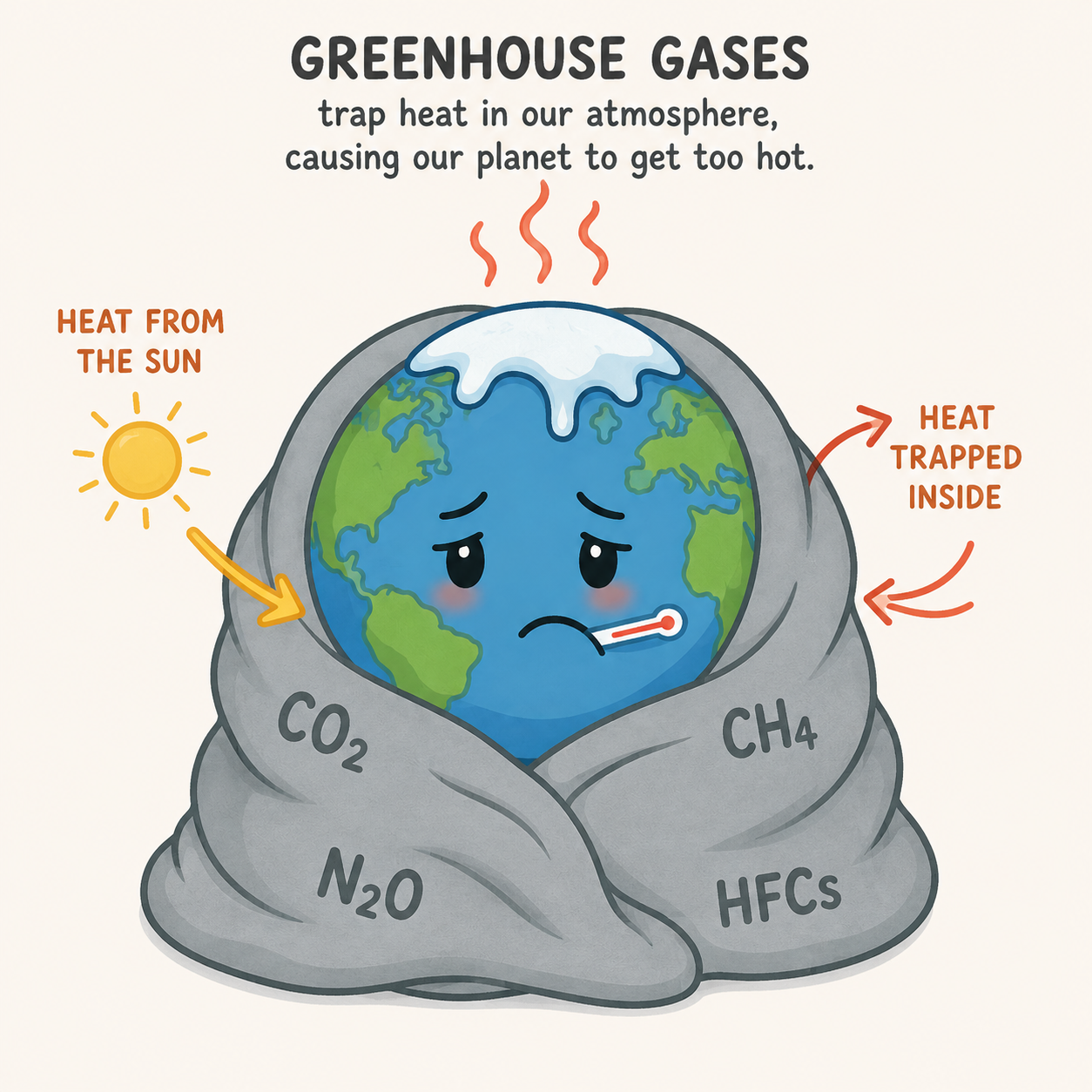
How Is the Climate Energy Hitting You?
Central England
Five Heatwaves, Official Drought, Record Wildfires, Hydroclimatic Whiplash, and the Worst Harvest on Record
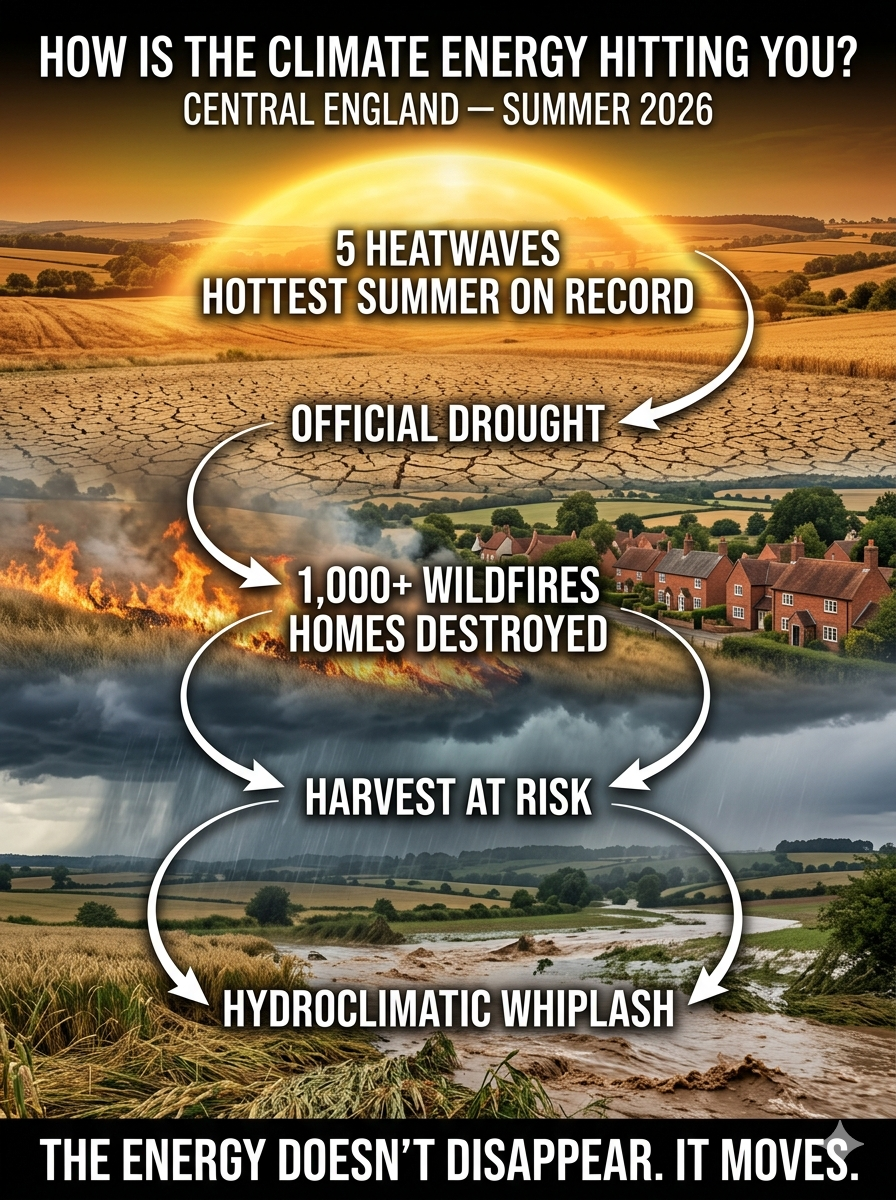
Central England is providing a very tangible demonstration of what climate energy looks like when it moves through a real landscape.
Not as an abstract temperature anomaly. Not as a number on a graph.
As heatwaves. Drought. Wildfires. Crop losses. Water restrictions. And then sudden, intense rainfall arriving on ground that has been baked hard by weeks of exceptional heat and dryness.
This is hydroclimatic whiplash: the rapid swing between one extreme hydrological condition and another.
Five Heatwaves — and Counting
Summer 2026 has already delivered a remarkable sequence of heatwaves across the United Kingdom. By August, the country had experienced a fifth heatwave, with the latest episode producing temperatures above 38°C in parts of England. Fire chiefs described the conditions as a sustained and escalating wildfire risk.
The Met Office has indicated that 2026 is on course to become the UK’s hottest summer on record, with the outlook particularly strong for England and Wales.
This isn’t simply five isolated hot spells.
Repeated heatwaves mean the landscape has less opportunity to recover between events. Soil moisture is depleted. Vegetation dries out. Rivers and reservoirs fall. Crops reach critical developmental stages under heat stress. Livestock experience thermal stress. And every subsequent heatwave starts from a more vulnerable baseline.
The energy isn’t disappearing when the thermometer comes back down.
It has already been transferred into the land, atmosphere, vegetation, water system and human infrastructure.
Drought: The Landscape Runs Out of Water
On July 29, the UK government officially declared drought across seven areas of England, including large portions of central, eastern and southern England. The government described much of the region as experiencing “flash drought,” driven by exceptionally low rainfall combined with high temperatures. Rivers were running low, farmers were harvesting early, wildfire risk was increasing and millions of people were facing water restrictions.
The situation continued to deteriorate.
By August, more than two-thirds of England had entered drought conditions. Reservoir storage had fallen to 69% and was declining, while more than 27 million people were living under water restrictions.
Official data for August 7–13 showed England receiving only 6% of its long-term average rainfall for the month to that point. Reservoir storage had fallen to 65.9%, 13.8 percentage points below the long-term average, while five reservoirs were classified as exceptionally low.
That is what a drought looks like when climate energy works through the water cycle.
The problem isn’t merely that it hasn’t rained.
It is that extraordinary heat increases evaporation and atmospheric demand for moisture while rainfall fails to replenish the system.
Then Comes the Deluge
And this is where the story gets particularly interesting.
After weeks of heat and dryness, rainfall doesn’t necessarily mean the drought is over.
When soils become severely dried and hardened, intense rainfall can run across the surface rather than infiltrating efficiently. Heavy showers and thunderstorms can therefore produce flash flooding even while the broader region remains in drought.
That apparent contradiction is becoming increasingly important.
England can simultaneously experience:
Drought underground.
Flooding on the surface.
Low reservoirs.
Overflowing drains.
Dry vegetation.
Rapid runoff.
This is hydroclimatic whiplash.
Recent forecasts and observations have already raised concerns that heavy rainfall following the prolonged drought could generate surface-water flooding without providing enough sustained precipitation to restore depleted soil moisture, groundwater and reservoirs.
A few hours of intense rain is not equivalent to weeks or months of accumulated rainfall.
The water has to be absorbed, stored and retained.
If it arrives too quickly, much of it simply moves downstream.
Wildfire: When the Landscape Becomes Fuel
The drought has also transformed the wildfire environment.
By August 10, firefighters in England and Wales had already responded to 966 wildfires in 2026, including 185 during the first ten days of August alone. July was the busiest month on record for wildfire incidents.
By August 16, the number had reached 1,132 wildfires across the UK—already exceeding the entire 2025 total, with months of the fire season still remaining.
The government eventually issued a national emergency alert warning of a very high wildfire risk across England and Wales.
And this was no longer simply a countryside problem.
In Stourbridge in the West Midlands, a grass fire spread rapidly into residential areas. Nineteen homes were destroyed and another 18 were damaged. Nearly 40 properties were affected.
The lesson is brutally simple:
When the countryside becomes tinder-dry, the boundary between wildfire and urban fire can disappear remarkably quickly.
Agriculture Takes the Hit
Perhaps the most consequential impact will not be visible in the flames.
It will be visible in the harvest.
The Energy and Climate Intelligence Unit’s August analysis found that the 2026 UK arable harvest was on track to become the worst on record. Initial yield estimates were already below the 10-year average for wheat, spring barley and oats.
Then the forecast deteriorated further.
Updated figures released August 14 put UK arable production at just 18.5 million tonnes, below the previous estimate of 19.5 million tonnes and approximately 1.35 million tonnes below the previous record-low harvest in 2020. ECIU estimated that the 2026 harvest could therefore become the smallest on record.
This is what happens when climate energy arrives at the wrong time.
Heat during crop development.
Drought during critical growth periods.
Accelerated maturation.
Reduced soil moisture.
Poor grass growth.
Heat-stressed livestock.
And then, potentially, heavy rainfall arriving after crops have already suffered.
The damage is not necessarily one spectacular event.
It is the accumulation of energy transfers occurring faster than agricultural systems can adapt.
The Climate Energy Doesn’t Disappear
This is the part of the story I think we frequently miss.
When the heatwave ends, we tend to assume the problem has ended.
It hasn’t.
The energy has moved.
Heat increases evaporation.
Evaporation removes water from soils and vegetation.
Dry vegetation becomes fuel.
Drought lowers river flows and reservoirs.
Wildfires transfer enormous amounts of energy into the atmosphere and destroy ecosystems and property.
Then storms can transfer atmospheric moisture into intense rainfall.
That rainfall can become runoff and flooding rather than useful groundwater recharge.
The system keeps moving.
One extreme can help create the conditions for the next.
Heat → drying → drought → wildfire → atmospheric instability → intense rainfall → runoff and flooding.
And then the cycle begins again.
Central England Is the Demonstration
Central England is not experiencing one climate problem.
It is experiencing a cascade.
Five heatwaves.
Official drought.
Record-low rainfall.
Depleted water resources.
Extreme wildfire conditions.
Homes destroyed.
Agricultural losses.
And now the possibility of intense rainfall and flash flooding arriving before the underlying drought has been repaired.
That is the important distinction.
Climate change isn’t simply about making today’s weather “hotter.”
It is about changing the amount of energy available to the climate system and altering how quickly that energy can move between the atmosphere, land, water and living systems.
The result can be greater volatility.
Longer extremes.
More rapid transitions.
And increasingly destructive combinations of events.
Central England is showing us what that looks like.
The question isn’t whether the climate energy is hitting us.
It is.
The question is:
Where does it go next?
And what happens when the next transfer arrives before the system has recovered from the last one?
Taking the Temperature of Climate Change: How Is Climate Energy Hitting You?
Easy-to-Read Resources