Transpiration, Atmospheric Moisture Recycling, and Climate-Driven Heat Stress in a Warming World
2Independent Physicist, Membrane Institute, USA
What is Transpiration?
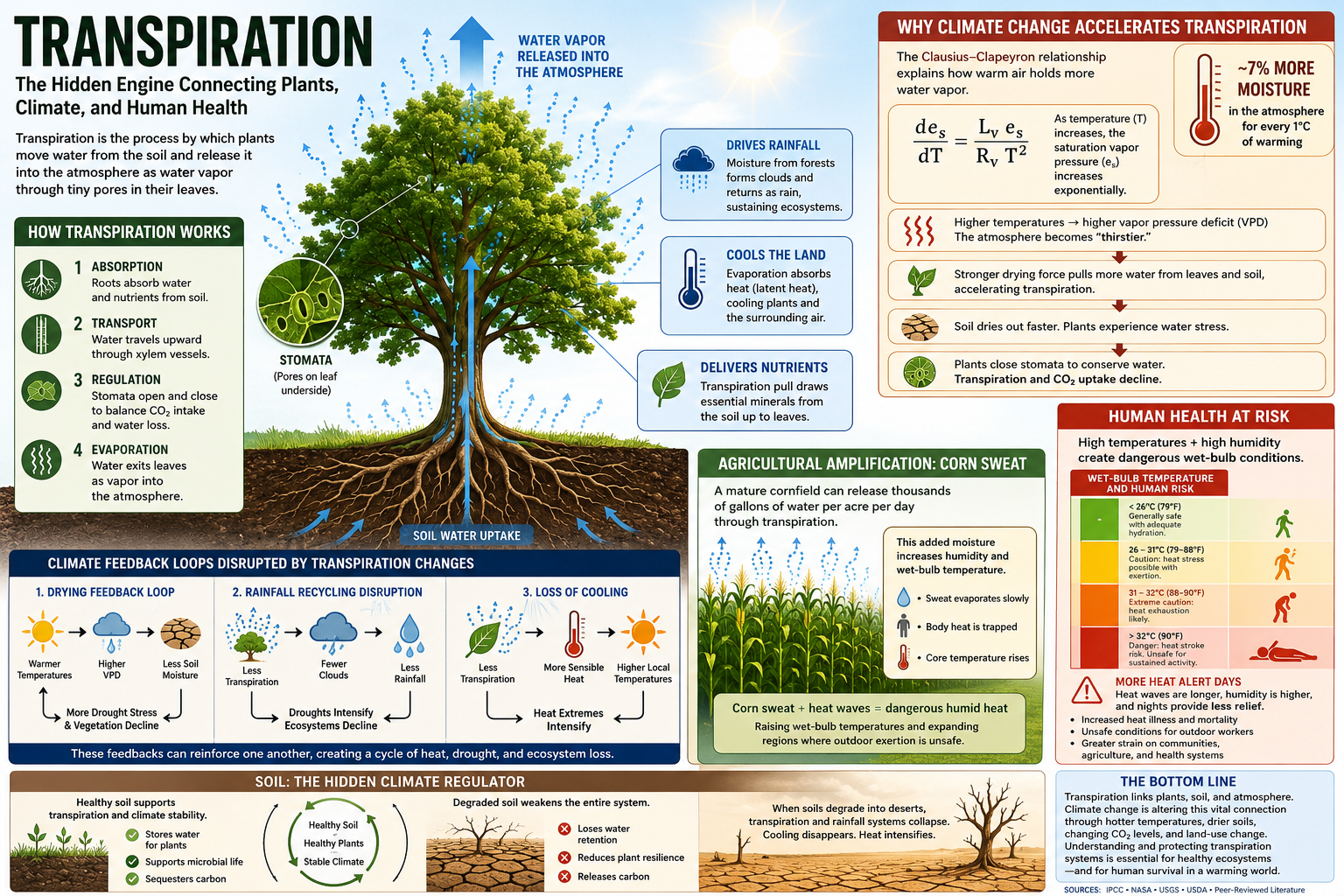
Transpiration is the biological process by which plants move water from the soil through their roots and vascular system and release it into the atmosphere as water vapor. This release occurs through microscopic pores on leaves called stomata, which also regulate carbon dioxide intake for photosynthesis.
In simple terms, transpiration is the plant equivalent of sweating:
- Plants absorb water from soil
- Transport it upward through xylem tissue
- Release it as vapor through leaf stomata
Although it is a natural biological function, transpiration is also a major component of Earth’s water cycle and climate system.
Why Transpiration Matters
1. Nutrient transport
Water pulled upward by transpiration carries essential minerals from soil into leaves and stems, enabling plant growth and metabolism.
2. Natural cooling system
When water evaporates from leaves, it absorbs energy as latent heat, cooling both the plant and surrounding air. Large forests can significantly reduce local temperatures through this process.
3. Rainfall and atmospheric moisture recycling
Ecosystems such as tropical rainforests return enormous amounts of water vapor to the atmosphere. This moisture contributes to cloud formation and rainfall, often sustaining the very ecosystems that produce it.
How Transpiration Works (Step-by-Step)
- Absorption: Roots draw water and dissolved nutrients from soil.
- Transport: Water moves upward through xylem under tension.
- Regulation: Stomata open and close to balance CO₂ intake and water loss.
- Evaporation: Water exits leaves as vapor, entering the atmosphere.
Transpiration and Climate Change: A Shifting System
Transpiration is highly sensitive to temperature, humidity, and atmospheric composition. As the climate warms, these conditions are changing rapidly—and not always in the same direction.
The Clausius–Clapeyron Relationship: Why Warm Air Changes Everything
A key physical principle in climate science is the Clausius–Clapeyron relationship, which states that warmer air can hold more water vapor.
In practical terms:
- For every ~1°C of warming, the atmosphere can hold about 7% more moisture
- This increases the atmosphere’s evaporative demand
This relationship drives a critical climate variable: vapor pressure deficit (VPD)—the difference between how much moisture air can hold and how much it actually contains.
As temperatures rise:
- VPD increases
- The atmosphere draws more moisture from soils and plants
- Evaporation and transpiration rates accelerate
This creates a powerful “drying force” on vegetation and soils.
Why Transpiration Can Increase—and Then Collapse
Climate change creates a competing set of forces:
1. Atmospheric acceleration (increased water loss)
- Higher temperatures increase evaporation demand
- Higher VPD pulls more moisture from leaves and soil
- Early warming stages often increase transpiration rates
2. Plant regulation (defensive shutdown)
Plants respond to water stress by closing stomata:
- Reduces water loss
- But also reduces CO₂ uptake
- Weakens photosynthesis and ecosystem productivity
At large scales, this can reduce regional moisture recycling.
Loss of Biosphere Cooling
Transpiration is also a major cooling mechanism for Earth’s surface.
When water evaporates from leaves:
- Energy is absorbed as latent heat
- Air temperatures are reduced locally
But when plants close stomata or soil moisture declines:
- Latent cooling weakens
- More solar energy becomes sensible heat
- Local temperatures rise further
This can intensify heat extremes during heat waves.
Forest Moisture Recycling and System Stability
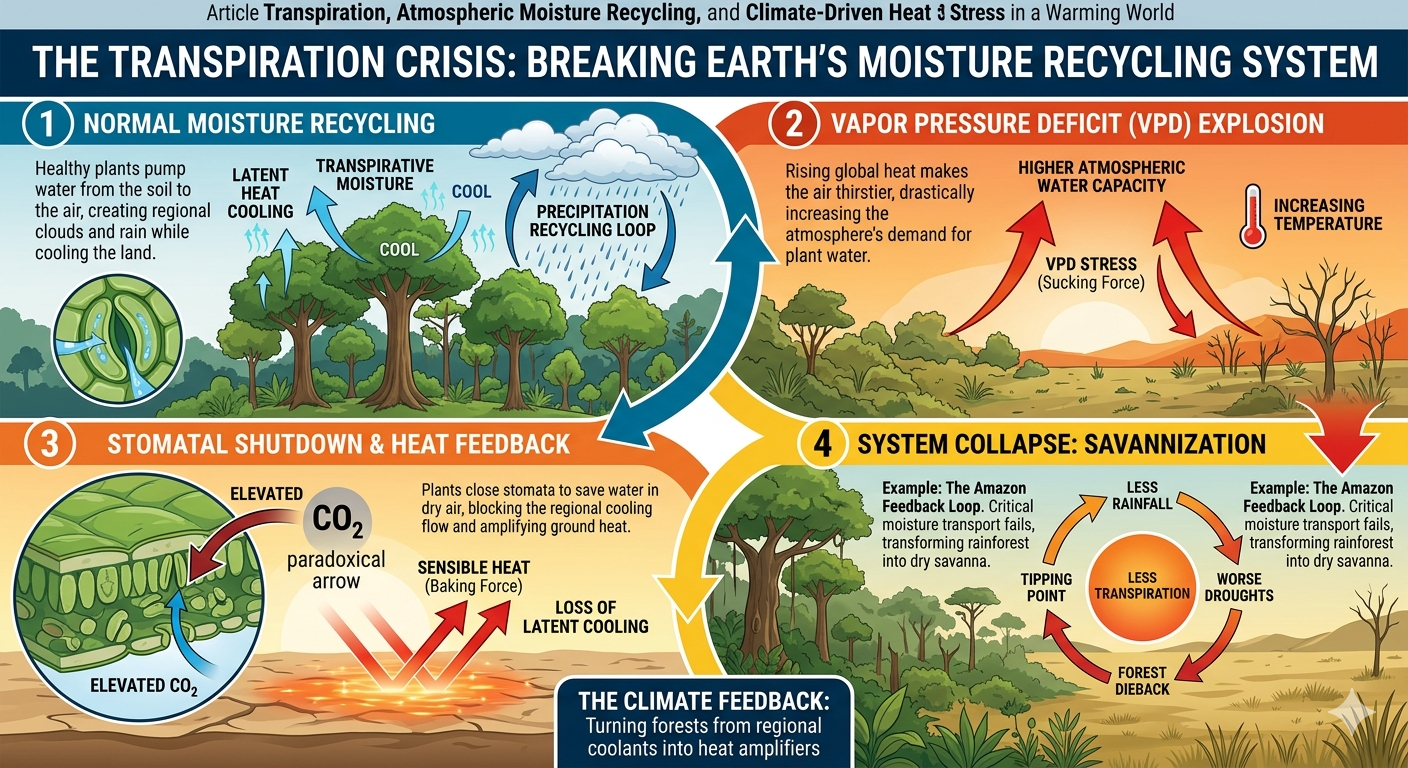
Large forests—especially tropical rainforests—depend on internal moisture recycling:
- Trees transpire water vapor
- Vapor forms clouds
- Clouds produce rainfall
- Rain sustains the forest
If transpiration declines:
- Rainfall decreases
- Dry seasons lengthen
- Vegetation stress increases
This creates a feedback loop:
less transpiration → less rainfall → more drought → further forest loss
Agricultural Amplification: Corn Sweat, Humidity, and Human Heat Risk
Large agricultural systems can significantly alter local atmospheric conditions through transpiration. One of the most well-known examples is “corn sweat.”
A mature cornfield during peak summer heat can release thousands of gallons of water per acre per day into the atmosphere. This moisture increases local humidity and can meaningfully alter how heat is experienced by humans.
From Heat to Danger: Why Humidity Matters
Human cooling depends on evaporation of sweat. When humidity is high:
- Sweat evaporates more slowly
- Body heat is trapped
- Core temperature rises faster
This is where wet-bulb temperature becomes critical.
Wet-bulb temperature combines:
- Air temperature
- Humidity
It represents the physical limit of human heat tolerance because it determines whether sweat can still cool the body.
Corn Sweat and Rising Wet-Bulb Stress
Corn transpiration adds moisture to air masses already warmed by climate change. When combined with rising temperatures:
- Atmospheric moisture increases
- Humidity rises sharply
- Wet-bulb temperature increases faster than air temperature alone
This combination can push conditions closer to dangerous physiological thresholds even when air temperature appears only moderately high.
Expanding Heat Danger into New Regions
Historically, dangerous humid heat in the United States was concentrated in:
- The Gulf Coast
- Parts of the Southeast
However, as climate patterns shift:
- Heat and humidity extremes are moving northward and inland
- The Midwest increasingly experiences high humidity heat events
- Regions like Iowa, Illinois, Indiana, Missouri, and Ohio are seeing more frequent dangerous combinations of heat and moisture
These are areas that historically did not experience prolonged conditions where outdoor physical activity becomes unsafe due to humidity-driven heat stress.
Heat Alert Days and Human Exposure
A growing concern is the increase in heat alert days—days when outdoor exertion becomes unsafe or strongly discouraged.
Contributing factors include:
- More frequent heat waves
- Higher humidity levels
- Reduced nighttime cooling
Impacts include:
- Increased heat exhaustion and heat stroke risk
- Reduced safe working hours for outdoor labor
- Greater strain on agriculture, construction, and public health systems
Importantly, risk is no longer defined by temperature alone. Humidity-driven heat stress is becoming a dominant factor.
Soil: The Hidden Climate Regulator
Soil plays a central role in regulating transpiration and climate stability.
Healthy soil:
- Stores water for plants
- Supports microbial ecosystems
- Helps regulate carbon cycling
Degraded soil:
- Loses moisture retention capacity
- Reduces plant resilience
- Releases stored carbon
When soils degrade into desertified states, transpiration systems weaken, reducing both cooling and rainfall feedbacks.
Conclusion
Transpiration is not just a plant process—it is a core component of Earth’s climate system. It links soil, vegetation, and atmosphere through continuous water and energy exchange.
Under climate change, transpiration is being reshaped by:
- The Clausius–Clapeyron-driven increase in atmospheric moisture capacity
- Rising vapor pressure deficits
- Plant stomatal responses to heat and CO₂
- Large-scale ecosystem stress and land-use change
These shifts affect not only ecosystems but also human health. Agricultural moisture release, such as corn sweat, interacts with warming temperatures to increase humidity and elevate wet-bulb temperatures—expanding regions where outdoor exertion becomes dangerous.
The result is a climate system in which biological, atmospheric, and human factors are increasingly interconnected—and increasingly strained under continued warming.
Also see: Soil's Crucial Role, Soil Degradation and Desertification
* Our probabilistic, ensemble-based climate model — which incorporates complex socio-economic and ecological feedback loops within a dynamic, nonlinear system — projects that global temperatures are becoming unsustainable this century. This far exceeds earlier estimates of a 4°C rise over the next thousand years, highlighting a dramatic acceleration in global warming. We are now entering a phase of compound, cascading collapse, where climate, ecological, and societal systems destabilize through interlinked, self-reinforcing feedback loops.
We examine how human activities — such as deforestation, fossil fuel combustion, mass consumption, industrial agriculture, and land development — interact with ecological processes like thermal energy redistribution, carbon cycling, hydrological flow, biodiversity loss, and the spread of disease vectors. These interactions do not follow linear cause-and-effect patterns. Instead, they form complex, self-reinforcing feedback loops that can trigger rapid, system-wide transformations — often abruptly and without warning. Grasping these dynamics is crucial for accurately assessing global risks and developing effective strategies for long-term survival.