New to the topic? Start here for an introduction to climate change and the fundamentals of healthy soil:
Soiled Soil: Climate Change and the Dirt on Dirt
What makes soil so crucial to addressing the climate crisis is its unique role in these interactions — soil is alive. Unlike the atmosphere or oceans, which are primarily composed of inorganic matter and operate as passive systems, soil is a living, dynamic medium that supports a vast array of organisms, from microbes to plant roots. These organisms play a central role in processes like carbon sequestration, nutrient cycling, and water retention, all of which directly influence climate stability. Soil offers the most adaptable and interactive mechanisms for slowing or preventing a wide range of climate feedback loops.
Soil's importance lies in its ability to store carbon. Healthy soil acts as a carbon sink, capturing and holding carbon dioxide from the atmosphere. However, when soil becomes degraded or erodes, this carbon is released back into the atmosphere, amplifying the effects of global warming.
When soil "dies," it undergoes a process known as desertification. Desertification is a critical state where once-fertile land becomes barren and incapable of supporting life, leading to the loss of its carbon sequestration capacity. This transformation not only reduces the soil's ability to mitigate climate change but also accelerates it, as barren land is often more prone to erosion and less able to retain moisture.
In this way, soil acts as both a barometer and a buffer in the climate system. Its health and vitality are intrinsically linked to the Earth's overall climate stability. Protecting and restoring soil is therefore not only about ensuring food security and biodiversity — it is about addressing one of the most pivotal elements of the climate crisis. Without healthy soil, efforts to mitigate climate change become far more challenging.
Soil plays a crucial role in climate change through several interconnected mechanisms:
Soil degradation contributes directly to desertification and amplifies systemic climate risk.
Research indicates that projected population density will intersect with extreme temperatures exceeding 29°C mean annual temperature (MAT), a condition currently limited to only 0.8% of Earth's land surface. Under medium-high emissions scenarios, by 2070 approximately 2 billion people may live in these regions. Today, only about 30 million people inhabit such areas, primarily in the Sahara and parts of the Gulf Coast.
Addressing soil degradation is essential for climate mitigation, ecosystem resilience, and long-term sustainability.
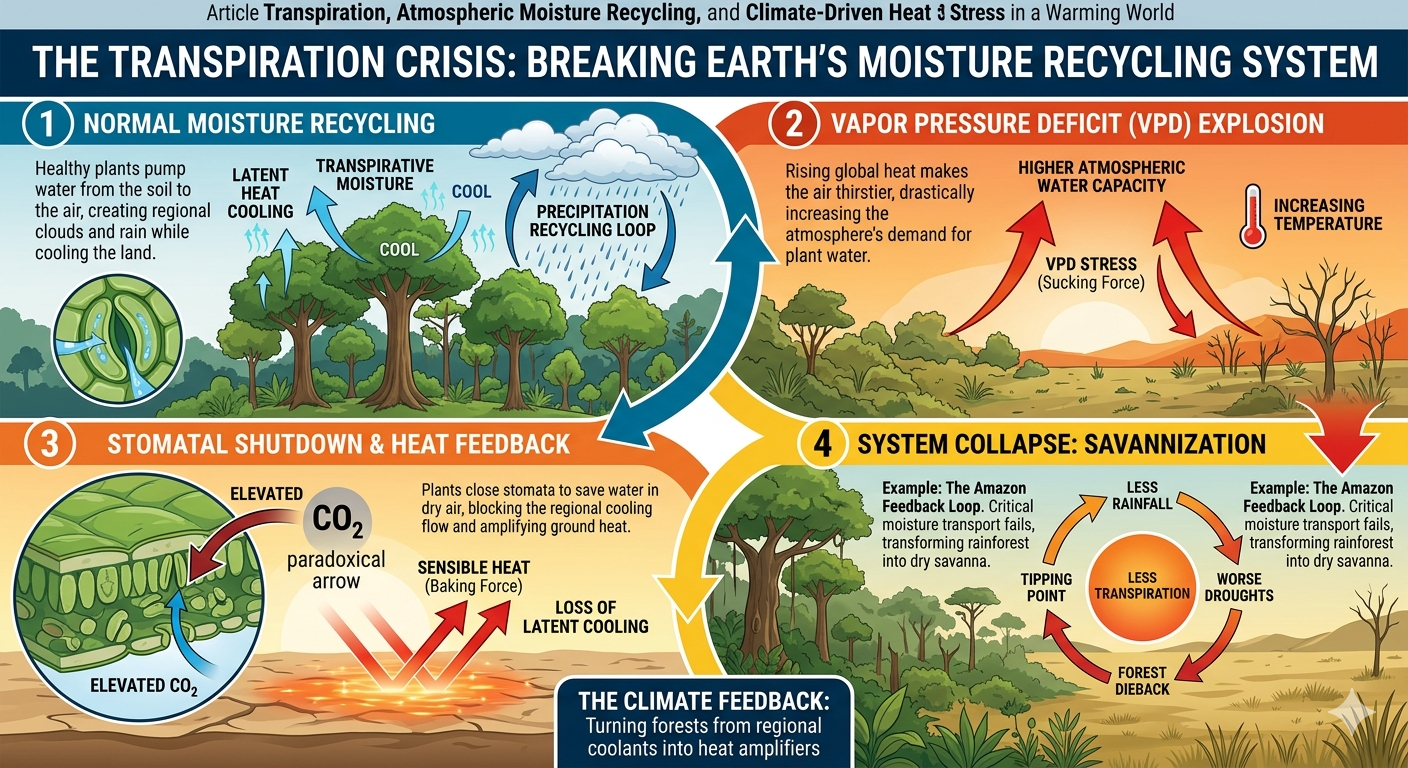
The paper Transpiration, Atmospheric Moisture Recycling, and Climate-Driven Heat Stress in a Warming World explains a key feedback loop: reduced transpiration → reduced rainfall → increased drought → further forest loss.
Transpiration is a core component of Earth’s climate system, linking soil, vegetation, and atmosphere through continuous water and energy exchange.
These shifts also affect human health by increasing humidity and wet-bulb temperatures, expanding regions where outdoor exertion becomes dangerous.
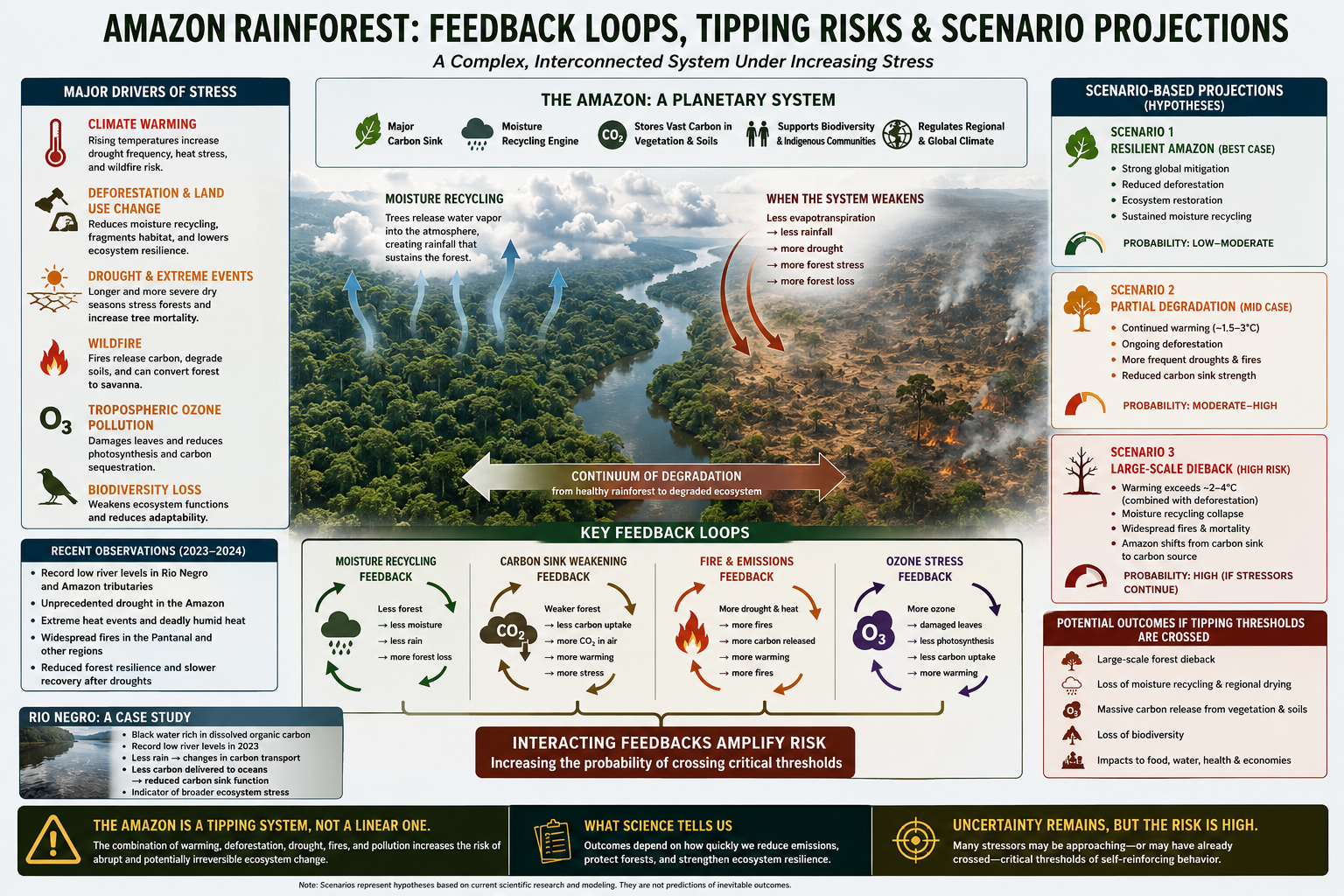
The paper Amazon Rainforest Dieback: Emerging Risks, Feedback Loops, and Scenario-Based Projections illustrates the processes of ecosystem collapse and savannization.
A growing body of research indicates that the system’s resilience may be declining under the combined influence of climate warming and land-use change. Several scenario-based projections suggest that continued warming, ongoing deforestation, and additional environmental stressors could increase the probability of large-scale forest degradation during the coming decades.The precise timing, magnitude, and interactions of these processes remain active areas of scientific investigation. Nevertheless, a growing body of observational evidence suggests that the risk is substantial. Multiple climate, ecological, and socio-economic systems are exhibiting behaviors consistent with increasing stress, declining resilience, and the emergence of self-reinforcing feedback mechanisms.
While significant uncertainties remain regarding specific thresholds and outcomes, there is increasing concern that some underlying stressors may be approaching—or in certain cases may have already crossed—critical tipping points beyond which system responses become increasingly difficult to predict, manage, or reverse. The central scientific challenge is therefore not simply determining whether such thresholds exist, but identifying where they lie, how rapidly they are being approached, and how interacting feedbacks may amplify risks across interconnected systems.
New to the topic? Start here for an introduction to climate change and the fundamentals of healthy soil:
Soiled Soil: Climate Change and the Dirt on Dirt
* Our probabilistic, ensemble-based climate model — which incorporates complex socio-economic and ecological feedback loops within a dynamic, nonlinear system — projects that global temperatures are becoming unsustainable this century. This far exceeds earlier estimates of a 4°C rise over the next thousand years, highlighting a dramatic acceleration in global warming. We are now entering a phase of compound, cascading collapse, where climate, ecological, and societal systems destabilize through interlinked, self-reinforcing feedback loops.
We examine how human activities — such as deforestation, fossil fuel combustion, mass consumption, industrial agriculture, and land development — interact with ecological processes like thermal energy redistribution, carbon cycling, hydrological flow, biodiversity loss, and the spread of disease vectors. These interactions do not follow linear cause-and-effect patterns. Instead, they form complex, self-reinforcing feedback loops that can trigger rapid, system-wide transformations — often abruptly and without warning. Grasping these dynamics is crucial for accurately assessing global risks and developing effective strategies for long-term survival.
Bottom line: The question is no longer how warm the planet becomes, but how life on Earth can endure when change outpaces our ability to adapt.
We cannot control the laws of physics, but we can control our pollution. The most effective action is to stop burning fossil fuels.