The Covenant of Balance:
An Interfaith Synthesis of Ecological Ethics, Economics, Climate Science, and Integrated Climate Stewardship
CHRISTIANITY — Creation care and stewardship.
ISLAM — Mīzān (balance) and responsible trusteeship.
JUDAISM — Bal tashchit (avoiding needless destruction and waste).
BUDDHISM — Interdependence, compassion, and mindful consumption.
HINDUISM — Dharma (duty), responsibility, and minimizing harm.
Overview
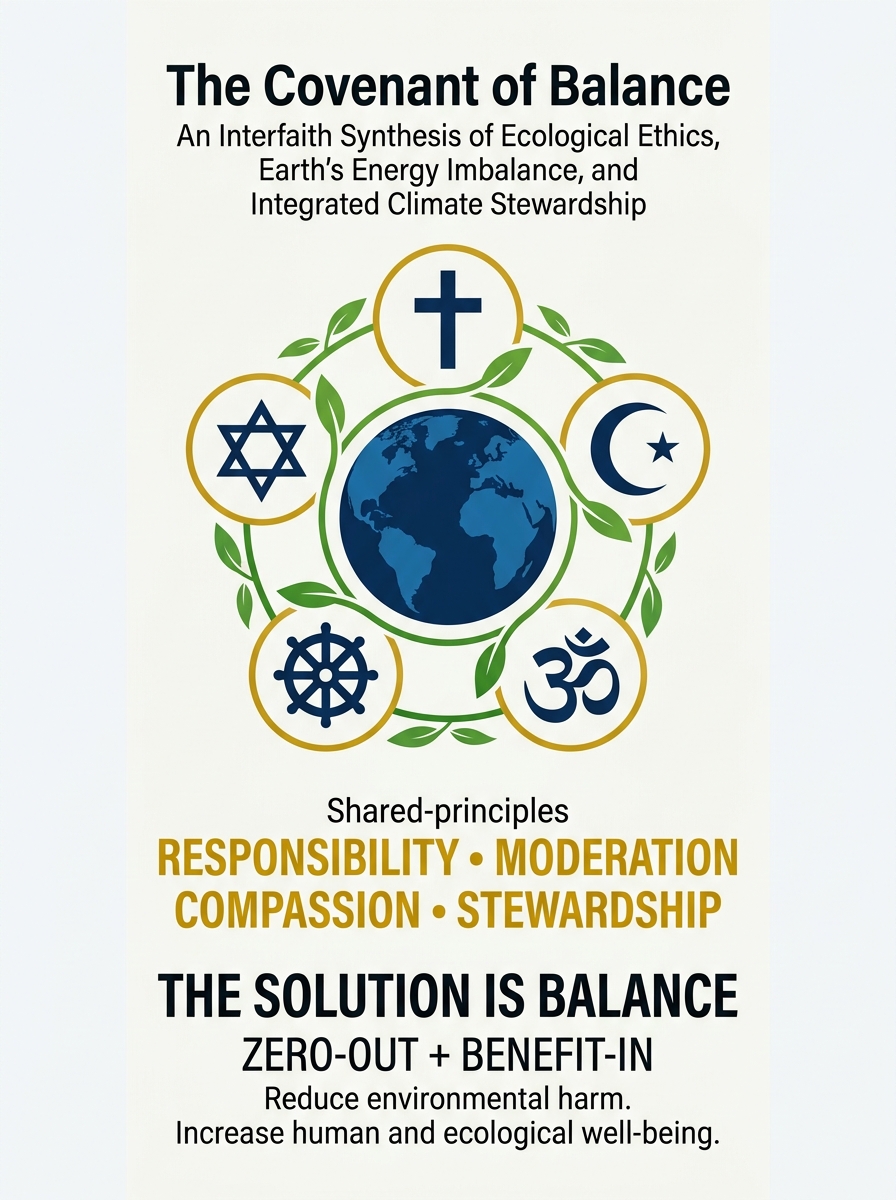
THE COVENANT OF BALANCE
An Interfaith Synthesis of Ecological Ethics, Earth’s Energy Imbalance, and Integrated Climate Stewardship
What do Christianity, Islam, Judaism, Buddhism, and Hinduism have in common when it comes to protecting our planet?
Although these five religious traditions differ in their beliefs and practices, each offers ethical principles that can help guide humanity toward a more responsible relationship with the Earth.
Christianity emphasizes creation care and stewardship.
Islam teaches Mīzān—balance—and responsible trusteeship.
Judaism emphasizes bal tashchit—avoiding needless destruction and waste.
Buddhism highlights interdependence, compassion, and mindful consumption.
Hinduism emphasizes dharma, responsibility, and minimizing harm.
Different traditions. Different teachings. A shared recognition that our actions have consequences.
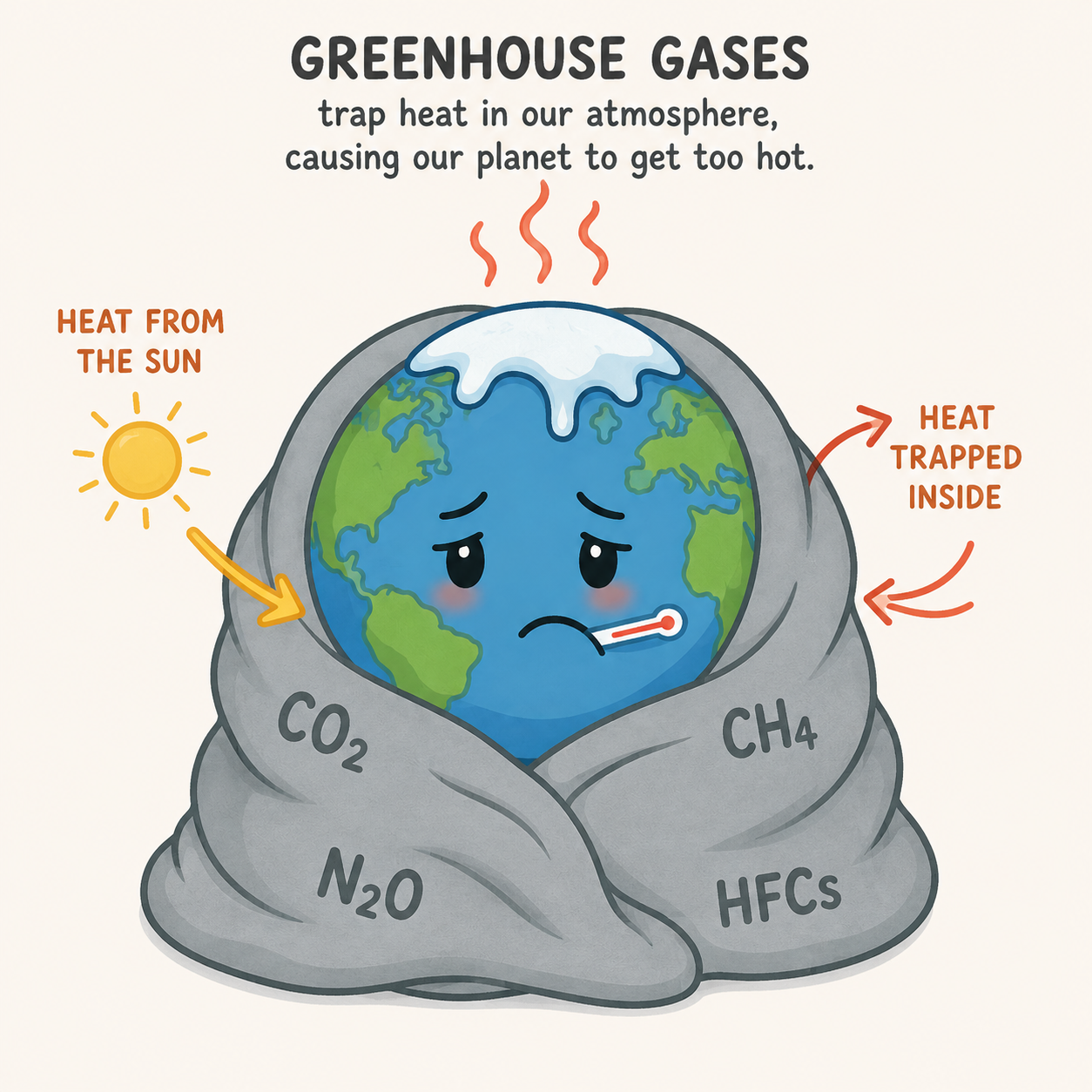
THE SCIENCE: Earth’s energy imbalance is driving climate change. Greenhouse gases trap additional energy in the Earth system, warming the oceans, atmosphere, and land while contributing to ice loss, rising seas, and ecological disruption. Interacting climate feedbacks can amplify these changes.
THE ETHICS: Our responsibility extends beyond ourselves—to other people, vulnerable communities, future generations, and the living systems that sustain us.
THE SOLUTION: BALANCE.
This paper connects these five religious traditions with two complementary frameworks:
Humanity’s Greatest Threat Is Humanity: Energy Imbalance → Climate Change → The Solution = Balance
Integrated Climate Stewardship: ZERO-OUT + BENEFIT-IN
ZERO-OUT means reducing actual sources of environmental harm. BENEFIT-IN means improving affordability, efficiency, resilience, comfort, and quality of life while protecting the natural systems on which we depend.
This is not a claim that all religions teach the same thing or agree on every environmental issue. It is an invitation to identify common ethical ground and turn shared concerns into practical, measurable action.
We do not need to share one religion to share responsibility for the Earth.
Five traditions. One interconnected planet. A common responsibility.
THE SOLUTION IS BALANCE.
Read the paper:
The Covenant of Balance: An Interfaith Synthesis of Ecological Ethics, Earth’s Energy Imbalance, and Integrated Climate Stewardship
Introduction
Humanity faces a profound ecological challenge: our economic systems, patterns of consumption, and exploitation of natural resources are disrupting the balance of Earth’s interconnected systems. Climate change is a central expression of this disruption, driven primarily by the accumulation of greenhouse gases that trap additional energy within the Earth system. Addressing this crisis requires scientific understanding, economic transformation, practical action, and an ethical framework capable of motivating change across cultures and societies.
This paper synthesizes five major religious traditions—Christianity, Islam, Judaism, Buddhism, and Hinduism—with two complementary frameworks: “Humanity’s Greatest Threat Is Humanity: Energy Imbalance → Climate Change → The Solution = Balance” and “Integrated Climate Stewardship.” Christianity is considered broadly across its Catholic, Orthodox, Protestant, evangelical, and other traditions. Pope Francis’s Laudato si’ and Laudate Deum are examined as influential Catholic contributions within the wider Christian conversation, alongside broader Christian teachings and initiatives concerning creation care.
Despite their theological differences, these traditions offer overlapping principles of responsibility, restraint, compassion, justice, and care for the living world. Their ethical insights can be connected with climate science and translated into practical action through Integrated Climate Stewardship: ZERO-OUT + BENEFIT-IN. This approach emphasizes eliminating or substantially reducing actual sources of environmental harm while bringing tangible benefits into daily life through lower costs, improved resource efficiency, greater resilience, and healthier communities.
The central proposition is that a sustainable future requires balance at multiple levels: physical, ecological, economic, social, and ethical. Religious traditions can help articulate why that balance matters; science can explain the physical processes involved; and practical stewardship can help translate shared values into measurable action.
1. Introduction: A Shared Responsibility for Our Common Home
Humanity is part of an interconnected living system. The atmosphere, oceans, forests, soils, freshwater systems, and countless forms of life interact through physical, chemical, and biological processes. Human societies depend on these systems for food, water, energy, shelter, health, and economic activity.
Yet many prevailing economic practices treat the natural world as an effectively unlimited source of materials and an unlimited destination for waste. The resulting pressures include climate change, biodiversity loss, deforestation, pollution, soil degradation, freshwater stress, and the depletion of natural resources.
Climate change makes the consequences of this imbalance particularly visible. Greenhouse gas emissions alter Earth’s energy balance, while interacting feedbacks and ecological changes can amplify the resulting impacts. The consequences extend beyond temperature: they include changes in precipitation, ice loss, sea-level rise, ecosystem disruption, agricultural stress, and risks to human health and economic stability.
The problem is scientific, but it is also ethical. Science can measure changing conditions and investigate their causes. It cannot, by itself, determine the full moral responsibilities of individuals, institutions, governments, or economic systems.
Religious and philosophical traditions have long explored questions of responsibility, restraint, justice, compassion, and humanity’s relationship with the natural world. Although their beliefs and practices differ, they offer resources for examining the values that shape human behavior.
This paper brings five traditions into conversation:
- Christianity, including Catholic, Orthodox, Protestant, evangelical, and other Christian perspectives.
- Islam, particularly the principles of Mīzān and Khilāfah.
- Judaism, including the principle of bal tashchit.
- Buddhism, including interdependence, compassion, and mindful consumption.
- Hinduism, including dharma, ahimsa, and reverence for the Earth.
The purpose is not to suggest that these traditions are identical or that their followers agree on every environmental question. It is to identify meaningful areas of convergence and connect them to a practical framework for ecological responsibility.
2. Christianity: Creation Care, Stewardship, and Love of Neighbor
Christian environmental ethics draws on a broad range of biblical teachings and theological traditions. Across Catholic, Orthodox, Protestant, evangelical, and other Christian communities, creation care has been understood through concepts such as stewardship, responsibility, humility, justice, and love of neighbor. Interpretations differ, and environmental responsibility is not expressed uniformly across all denominations.
Several biblical passages are particularly relevant.
Genesis 2:15 describes humanity’s placement in the garden of Eden to work it and keep it. This passage supports an understanding of human responsibility that includes both productive use and protection of the natural world.
Psalm 24:1 declares that the Earth belongs to the Lord. This can be understood as a challenge to the assumption that human ownership confers unlimited moral permission to destroy or exhaust the resources on which other life depends.
Romans 8:19–23 portrays creation as groaning and awaiting liberation. Christian environmental thinkers have drawn on this passage to reflect on ecological suffering and the relationship between human redemption and the wider creation.
Christian traditions also emphasize love of neighbor. Environmental degradation disproportionately affects people with limited resources, including communities exposed to extreme heat, flooding, drought, pollution, food insecurity, and displacement. Climate responsibility can therefore be understood as an expression of concern for vulnerable people, future generations, and the conditions necessary for human flourishing.
Christian contributions to ecological responsibility
Several major initiatives illustrate the breadth of Christian environmental engagement.
Pope Francis’s Laudato si’: On Care for Our Common Home (2015) presents an influential Catholic account of ecological responsibility, linking environmental degradation with social inequality, consumerism, economic priorities, and the need for an integrated response. Laudate Deum (2023) further emphasizes the urgency of the climate crisis and the inadequacy of responses that fail to match the scale of the problem.
These documents are important contributions to Christian environmental thought, but they do not represent every Christian denomination or establish a single environmental doctrine binding on all Christians.
Other examples include the World Council of Churches’ work on climate justice and ecological sustainability, the Lausanne Movement’s Cape Town Commitment and its wider evangelical discussions of creation care, and environmental initiatives within evangelical Christianity, including the Evangelical Environmental Network.
Together, these efforts demonstrate that ecological responsibility is discussed across multiple Christian traditions, even where theological interpretations, political priorities, and preferred policy responses differ.
The broader Christian contribution to an interfaith framework can be expressed through three connected principles:
- Creation care: The natural world is not merely a disposable storehouse of resources.
- Responsible stewardship: Human power over nature entails obligations, not unlimited permission to exploit.
- Love of neighbor: Environmental decisions should consider their consequences for other people, especially vulnerable communities and future generations.
These principles connect naturally with the concept of balance: humanity’s use of the Earth should sustain the conditions that make life possible rather than progressively undermine them.
3. Islam: Mīzān, Khilāfah, Tawḥīd, and Iqtisād
Islamic environmental ethics provides a particularly direct vocabulary for connecting ecological responsibility with balance.
Mīzān refers to balance, measure, and equilibrium. In the Qur’anic context, it conveys an order that should not be violated through excess or injustice. Applied to environmental responsibility, it encourages human beings to respect the limits, relationships, and conditions that sustain the natural world.
Khilāfah expresses humanity’s role as steward or trustee. Human beings exercise influence over the Earth, but that responsibility can be understood as an obligation to protect and manage creation rather than a license for unlimited exploitation.
Tawḥīd, the oneness of God, provides a theological foundation for understanding creation as an interconnected whole. Although the natural world contains immense diversity, its components exist within relationships that human activity can disrupt.
Iqtisād emphasizes moderation, economy, and avoiding excess. It challenges wasteful consumption and encourages responsible use of resources.
These principles are reflected in Al-Mizan: A Covenant for the Earth, launched in 2024 through an initiative associated with the United Nations Environment Programme’s Faith for Earth work. The document presents an Islamic framework for ecological responsibility, connecting spiritual principles with conservation, sustainability, and collective action.
Its contribution to this synthesis is the explicit connection between balance, trusteeship, moderation, and responsibility for the natural world.
4. Judaism: Bal Tashchit and Responsibility for Creation
Jewish environmental ethics includes the principle of bal tashchit, commonly understood as a prohibition against needless destruction or waste.
The principle is traditionally associated with Deuteronomy 20:19–20, which restricts the destruction of fruit-bearing trees during a siege. Its interpretation has extended into broader discussions of waste, resource conservation, and unnecessary harm.
Jewish teachings also draw on the creation narratives of Genesis, including the responsibilities associated with humanity’s place in the garden. As in Christianity, interpretations of dominion and human authority over nature vary, but Jewish environmental thought offers substantial resources for understanding human power as carrying moral obligations.
The Rabbinical Assembly’s The Green Covenant: A Jewish Pledge Toward Carbon Neutrality illustrates an effort to translate Jewish environmental values into institutional and practical commitments.
The relevance of bal tashchit extends beyond recycling or avoiding the waste of individual objects. It invites a broader question: when human activities needlessly damage ecosystems, squander resources, or impose preventable costs on future generations, what responsibility follows?
In the context of climate change, this principle supports reducing avoidable emissions, conserving energy and materials, preventing pollution, and questioning economic practices that generate unnecessary environmental damage.
5. Buddhism: Interdependence, Compassion, and Mindful Consumption
Buddhist teachings offer an ethical perspective centered on the interconnected nature of existence, the reduction of suffering, compassion, and awareness of the consequences of one’s actions.
Interdependence challenges the idea that human well-being can be separated from the well-being of other living systems. Food, water, climate, health, and economic stability depend on relationships among people, ecosystems, and physical processes.
Compassion extends ethical concern beyond the self. Environmental damage becomes relevant not only because it affects human comfort or prosperity, but also because it can cause suffering among vulnerable people and other living beings.
Mindful consumption encourages reflection on desire, attachment, and the consequences of acquiring and using material goods. It does not necessarily require rejecting technology or material comfort. Rather, it questions patterns of consumption that create harm without corresponding benefits to well-being.
The Time to Act Is Now: A Buddhist Declaration on Climate Change represents a Buddhist contribution to the climate discussion, emphasizing the relationship between climate responsibility, ethical conduct, and the need for action.
From this perspective, stewardship requires more than technical efficiency. It also involves examining the motivations and social arrangements that drive waste, excessive consumption, and disregard for the consequences of human behavior.
6. Hinduism: Dharma, Ahimsa, and Reverence for the Earth
Hindu traditions encompass a wide range of philosophies, practices, and interpretations. Environmental ethics within these traditions can draw on dharma, ahimsa, and reverence for the Earth.
Dharma can refer to duty, right conduct, and the responsibilities that sustain personal and social order. Environmental responsibility can be understood as part of fulfilling obligations to other living beings, communities, and the conditions that support life.
Ahimsa, commonly understood as nonviolence or the avoidance of harm, provides a basis for considering how human actions affect living beings and ecological systems. Its application to environmental issues varies across traditions, but it encourages attention to avoidable injury and destruction.
Hindu traditions also include forms of reverence for rivers, mountains, forests, animals, and the Earth itself. Bhūmi Devi, the Earth goddess, is one expression of the spiritual significance attributed to the Earth in Hindu traditions.
The Hindu Declaration on Climate Change, associated with the 2015 interfaith climate initiatives, articulates a Hindu contribution to the moral case for climate action and ecological responsibility.
These ideas connect environmental stewardship with duty, restraint, and respect for the living world. They encourage a view of human prosperity that does not depend on treating nature as morally irrelevant or endlessly expendable.
7. A Shared Ethical Framework Across Five Traditions
The five traditions differ in theology, scripture, spiritual practice, and their understanding of humanity’s place in creation. They should not be collapsed into a single religious doctrine. Nevertheless, their environmental teachings reveal several important areas of convergence.
| Tradition | Relevant principles | Environmental implication |
|---|---|---|
| Christianity | Creation care, stewardship, love of neighbor | Protect creation and consider the consequences for vulnerable people and future generations |
| Islam | Mīzān, Khilāfah, Tawḥīd, Iqtisād | Respect balance, exercise responsible trusteeship, recognize interconnection, and avoid excess |
| Judaism | Bal tashchit, responsibility for creation | Prevent needless destruction and waste |
| Buddhism | Interdependence, compassion, mindful consumption | Reduce avoidable harm and reconsider excessive consumption |
| Hinduism | Dharma, ahimsa, reverence for the Earth | Fulfill responsibilities and minimize harm to living systems |
These parallels are meaningful, but they are not exact equivalences. Mīzān, for example, has a specific Qur’anic and Islamic context; bal tashchit has a distinct Jewish history; and Buddhist interdependence does not simply mean the same thing as Christian stewardship or Hindu dharma.
The common ground is more practical than doctrinal: human decisions affect interconnected systems, and ethical responsibility requires attention to the consequences of those decisions.
An interfaith environmental framework can therefore rest on several shared commitments:
- Reduce avoidable harm.
- Use resources responsibly.
- Avoid unnecessary waste and excess.
- Protect the conditions that sustain life.
- Consider the needs of vulnerable communities.
- Recognize obligations to future generations.
- Translate ethical commitments into measurable action.
This is the foundation for connecting religious ethics with the scientific and practical framework developed in the two papers considered here.
8. The Scientific Foundation: Energy Imbalance and Climate Change
Religious ethics can motivate responsibility, but climate science must establish the physical processes and evidence involved.
Earth receives energy from the Sun and returns energy to space. Over time, the amount entering and leaving the Earth system determines whether the planet gains or loses energy.
Human-caused greenhouse gas emissions have altered this balance by reducing the rate at which Earth loses energy to space. The result is a positive energy imbalance: more energy accumulates within the Earth system than leaves it.
The oceans absorb the great majority of the excess heat accumulating in the climate system. Energy is also taken up by the atmosphere, land, and cryosphere. The consequences include rising temperatures, ocean warming, melting land ice, sea-level rise, and changes in the behavior of ecosystems and atmospheric circulation.
The central distinction is that climate change is not simply a problem of elevated surface temperature. Temperature is one indicator of a wider physical process involving energy storage, redistribution, and changes across interconnected systems.
From imbalance to interacting feedbacks
Climate systems contain feedback processes that can amplify or moderate an initial change. Examples include:
- Ice and snow loss, which reduces reflectivity and allows more solar energy to be absorbed.
- Changes in atmospheric water vapor, which affect the greenhouse effect.
- Changes in clouds, which can alter both incoming solar radiation and outgoing infrared radiation.
- Changes in ecosystems and vegetation, which can influence carbon storage, surface reflectivity, moisture, and local climate.
- Ocean circulation changes, which redistribute heat and influence regional climate patterns.
These processes do not all operate in the same direction or with the same strength. Their effects depend on location, timescale, and the interactions among physical and biological systems.
The broader scientific concern is that feedbacks can interact. Multiple changes may reinforce one another, increase stress on ecosystems, and make the consequences of continued warming more severe.
The distinction between an ethical principle and a physical measurement is essential. Religious concepts of balance can help explain why disruption is morally significant, but they are not substitutes for observations, measurements, and scientific models. Conversely, climate science can describe physical changes without independently determining every ethical obligation arising from them.
The synthesis proposed here uses each framework for its appropriate purpose: ethics clarifies responsibility, science investigates the physical problem, and stewardship translates both into action.
9. Humanity’s Greatest Threat Is Humanity: Energy Imbalance → Climate Change → The Solution = Balance
The paper Humanity’s Greatest Threat Is Humanity: Energy Imbalance → Climate Change → The Solution = Balance presents balance as a central organizing principle for understanding the climate crisis and responding to it.
The sequence begins with human activities that alter Earth’s energy balance. These activities include greenhouse gas emissions from fossil fuels, land-use changes, and other human-caused influences on the climate system.
The resulting energy imbalance drives warming and contributes to changes in oceans, ice, weather patterns, ecosystems, and the distribution of heat and moisture.
The effects then interact with human systems. Agricultural disruption can affect food prices and availability. Environmental damage can increase economic losses and displacement. Resource stress can intensify existing inequalities and political pressures.
This sequence does not mean that every climate impact follows one inevitable pathway, or that every feedback leads to collapse. It means that environmental, economic, and social risks are connected and should not be evaluated as isolated problems.
Balance is the proposed solution in the sense of restoring conditions that support long-term stability and human flourishing. Physically, that requires reducing greenhouse gas emissions and ultimately bringing the climate system toward a sustainable energy balance. Ecologically, it requires protecting and restoring the systems that support life. Economically, it requires reconsidering practices that depend on unlimited material throughput and the externalization of environmental costs.
Ethically, balance means recognizing that short-term gains for some can impose lasting costs on others.
The religious traditions examined here provide different reasons for accepting these responsibilities. Their shared contribution is not a claim that the Earth must remain static or that all change is harmful. Rather, they support the principle that human power should be exercised with regard for consequences, limits, and obligations to others.
10. Integrated Climate Stewardship: ZERO-OUT + BENEFIT-IN
Integrated Climate Stewardship translates environmental responsibility into a practical framework for everyday life, businesses, institutions, and public policy.
Its central formula is:
ZERO-OUT + BENEFIT-IN
ZERO-OUT means eliminating or substantially reducing actual sources of environmental harm wherever practical. This includes reducing unnecessary energy use, fossil fuel consumption, waste, pollution, and resource-intensive activities.
BENEFIT-IN means choosing changes that also produce tangible benefits: lower utility bills, reduced operating costs, greater resilience, improved comfort, healthier living conditions, and more efficient use of resources.
The framework is intended to make climate stewardship a practical part of ordinary life rather than an obligation dependent entirely on sacrifice, charitable contributions, or distant technological promises.
Examples include:
- Improving building efficiency and reducing unnecessary heating and cooling.
- Using targeted heating and cooling rather than conditioning unused spaces.
- Reducing electricity and hot-water demand.
- Repairing, reusing, and maintaining products to extend their useful lives.
- Reducing food waste and choosing efficient food-storage and preparation practices.
- Using durable, efficient equipment when the total costs and environmental benefits justify it.
- Protecting trees, soil, water, and vegetation where they provide measurable ecological benefits.
- Improving household and community resilience to heat, storms, flooding, and power interruptions.
Not every action will be appropriate for every household or region. Costs, safety, building conditions, local climate, access to technology, and the environmental impacts of equipment all matter. The goal is to identify measures that produce real net benefits rather than simply shifting environmental costs from one place to another.
Why benefits matter
Climate communication often emphasizes costs, restrictions, and sacrifices. These are sometimes unavoidable, particularly when major structural changes are necessary. But stewardship can also produce immediate personal and social benefits.
Lower energy demand can reduce bills. Durable products can reduce replacement costs. Improved building performance can increase comfort. Better preparedness can limit losses during disruptions. Reducing waste can save money while reducing pressure on natural resources.
These benefits can make climate action more accessible to people who might otherwise see it as financially burdensome or disconnected from their daily lives.
The approach also helps distinguish genuine emissions reductions from accounting exercises. Offsets do not automatically eliminate the underlying source of pollution, and their quality varies. ZERO-OUT prioritizes direct reductions; BENEFIT-IN encourages additional improvements that support ecological and human well-being.
The framework does not imply that individual household measures alone can solve climate change. Electricity generation, industrial production, transportation, agriculture, infrastructure, and public policy remain essential. Individual action is most effective when supported by changes in the larger systems that shape available choices.
11. Economic Balance: Prosperity Without Ecological Destruction
Economic systems are human institutions, not independent forces beyond human responsibility. Their incentives, rules, and measures of success influence how resources are extracted, distributed, consumed, and discarded.
Traditional measures of economic activity can rise while natural capital declines. Gross domestic product, for example, does not by itself distinguish between productive investment, resource depletion, environmental restoration, and expenditures required to repair damage.
An economy can therefore report growth while imposing costs on ecosystems, public health, future generations, or communities that lack the power to avoid those costs.
A more integrated understanding of prosperity considers not only the production of goods and services but also the durability of the ecological systems on which economic activity depends.
This does not require rejecting markets, innovation, or economic growth in every form. It requires evaluating economic activity according to its full consequences rather than treating environmental costs as someone else’s problem.
A practical stewardship framework asks:
- Does this activity meet a genuine need or produce a meaningful benefit?
- Can the same benefit be achieved with less energy or fewer materials?
- Are environmental costs being imposed on other people or future generations?
- Does the activity strengthen or undermine long-term resilience?
- Can waste be prevented at the source rather than managed after it occurs?
- Do the financial incentives reward conservation and efficiency, or excessive extraction and disposal?
These questions connect the religious principle of moderation with economic accountability. They also connect scientific knowledge about finite ecological capacities with the practical task of designing better incentives and institutions.
The aim is not balance for its own sake as an abstract slogan. It is an economic system that can support human well-being without progressively undermining the natural systems that make prosperity possible.
12. Justice, Vulnerability, and Future Generations
Environmental damage is not distributed evenly. Communities differ in their exposure to hazards, their access to resources, their capacity to recover, and their historical contribution to environmental pressures.
Low-income households may have fewer options for improving inefficient housing or recovering from extreme weather. Coastal communities may face growing flood and erosion risks. Agricultural communities may be exposed to changing rainfall patterns, heat, and crop stress. People with limited access to healthcare, reliable infrastructure, or financial reserves may suffer disproportionately from environmental disruption.
These inequalities make climate stewardship a question of justice as well as physical science.
Christian teachings on love of neighbor, Islamic concepts of trusteeship and justice, Jewish obligations against needless destruction, Buddhist compassion, and Hindu principles of duty and minimizing harm can all contribute to discussions of how environmental costs and responsibilities should be shared.
The traditions do not necessarily prescribe identical policies. Nevertheless, their ethical resources support asking who benefits from environmentally damaging activities, who bears the costs, and whose needs are excluded from decision-making.
Future generations are particularly important because they cannot participate directly in current decisions, even though they may inherit the consequences. Stewardship therefore requires a time horizon longer than an election cycle, quarterly earnings report, or individual consumer decision.
A balanced approach must consider the rights and needs of people who have little influence over the choices that shape their future.
13. Indigenous Knowledge and Local Stewardship
Indigenous peoples and local communities hold diverse traditions of environmental knowledge, place-based observation, and resource management. These traditions are not uniform, and they should not be romanticized as though every community has identical practices or perspectives.
In many places, however, Indigenous knowledge contributes valuable understanding of ecosystems, seasonal changes, species relationships, fire management, water, soils, and long-term landscape stewardship.
Such knowledge can complement scientific research when collaboration respects community authority, cultural context, and rights over traditional knowledge. It should not be appropriated without consent or treated as a substitute for the participation of the people who hold it.
The interfaith framework developed here reinforces the importance of humility: no single institution, discipline, or tradition possesses every insight required to address complex environmental problems.
Effective stewardship draws on scientific evidence, local experience, ethical reflection, and the participation of communities directly affected by environmental decisions.
14. From Shared Values to Measurable Action
An interfaith agreement on environmental responsibility becomes meaningful when it leads to action. Broad ethical commitments can be translated into a practical program for households, congregations, schools, businesses, communities, and governments.
Individuals and households
- Measure energy and resource use before choosing improvements.
- Reduce avoidable consumption and waste.
- Prioritize practical efficiency measures with favorable costs and benefits.
- Protect and restore local ecosystems where feasible.
- Prepare for climate-related hazards.
- Evaluate actions according to actual outcomes rather than appearances.
Faith communities
- Incorporate creation care and environmental responsibility into education and community service.
- Improve the efficiency of buildings and facilities.
- Reduce food, water, energy, and material waste.
- Support vulnerable households facing environmental hazards.
- Encourage cooperation among religious traditions without erasing their differences.
- Publish measurable goals and report progress honestly.
Businesses and institutions
- Identify environmental costs throughout operations and supply chains.
- Reduce emissions and waste at their sources.
- Evaluate investments using long-term costs and risks.
- Improve product durability, repairability, and resource efficiency.
- Avoid presenting symbolic commitments as substitutes for measurable reductions.
Governments and public institutions
- Align infrastructure and energy decisions with credible climate science.
- Support efficiency improvements and practical emissions reductions.
- Protect public health and communities exposed to environmental hazards.
- Incorporate environmental costs into economic decision-making.
- Encourage innovation while evaluating its full environmental consequences.
- Provide transparent data so progress can be independently assessed.
A common standard of accountability
Regardless of the religious, philosophical, or secular motivation behind an action, its environmental performance should be evaluated using evidence.
Relevant measures include energy consumption, greenhouse gas emissions, waste generation, water use, ecosystem condition, financial cost, resilience, and health outcomes.
Ethical intention matters, but good intentions alone do not establish that a practice is environmentally effective. Similarly, a measurable improvement does not eliminate the need to consider justice, consent, or other ethical questions.
The combination of moral purpose and measurable results provides a stronger basis for lasting stewardship.
15. An Interfaith Covenant of Balance
The traditions examined in this paper can contribute to a common commitment without requiring agreement on every theological question.
Such a covenant might be expressed through the following principles:
Respect the conditions that sustain life. Recognize that human prosperity depends on interconnected physical, ecological, and social systems.
Exercise power responsibly. Treat technological, economic, and political influence as carrying obligations to other people and the natural world.
Reduce needless harm. Avoid waste, pollution, and destructive practices when effective alternatives are available.
Practice moderation without rejecting well-being. Distinguish genuine human needs and benefits from unnecessary consumption that imposes disproportionate costs.
Protect the vulnerable. Consider the people and communities most exposed to environmental harm and least able to recover.
Preserve opportunities for future generations. Avoid decisions that create preventable, long-lasting damage for people who cannot participate in current choices.
Turn values into action. Establish practical goals, measure results, and revise ineffective approaches.
Cooperate across differences. Work with people of different religions, philosophies, and scientific disciplines while respecting their distinct beliefs and perspectives.
This covenant is a proposed synthesis, not an official declaration adopted by the five religious traditions. Its purpose is to identify a shared practical direction that can support cooperation without pretending that important differences do not exist.
16. Conclusion: The Solution Is Balance
Climate change is a physical consequence of a disrupted Earth energy balance, but the decisions that contribute to it are made within human economic, political, cultural, and ethical systems.
The scientific challenge is to understand the changes occurring across the Earth system, reduce the human causes of warming, and protect the ecological systems that sustain life. The ethical challenge is to recognize responsibility for the consequences of human choices. The practical challenge is to translate that responsibility into effective, affordable, and measurable action.
Christianity, Islam, Judaism, Buddhism, and Hinduism approach these questions through distinct teachings and traditions. Their concepts should not be treated as interchangeable, and their followers do not hold a single universal position on every environmental issue. Yet each tradition offers resources for considering responsibility, restraint, compassion, justice, or humanity’s relationship with the living world.
Christian creation care, Islamic Mīzān, Jewish bal tashchit, Buddhist interdependence, and Hindu dharma provide different ethical paths toward examining the consequences of human behavior. These paths can converge in practical commitments to reduce harm, conserve resources, protect vulnerable communities, and preserve the conditions necessary for future life.
The two complementary frameworks considered here connect these commitments with scientific understanding and everyday practice.
“Humanity’s Greatest Threat Is Humanity: Energy Imbalance → Climate Change → The Solution = Balance” identifies the disruption of Earth’s energy balance as a central physical dimension of the climate crisis and presents balance as a guiding principle for the response.
“Integrated Climate Stewardship” translates that principle into the practical formula ZERO-OUT + BENEFIT-IN: reduce actual sources of environmental harm while creating tangible benefits through efficiency, affordability, resilience, and improved quality of life.
Balance does not mean keeping every natural system unchanged, returning humanity to a preindustrial past, or requiring every community to follow the same path. It means recognizing physical limits, respecting ecological relationships, accounting for the consequences of economic activity, and exercising human power responsibly.
Religious ethics can help explain why stewardship matters. Climate science can establish what is happening and evaluate possible responses. Economic analysis can help identify costs, incentives, and opportunities. Practical action can turn these insights into measurable improvements.
The ultimate goal is not simply to slow environmental damage. It is to build a way of living and organizing society that supports human well-being while preserving the natural systems on which that well-being depends.
Humanity does not need to share one religion to share responsibility for the Earth. Nor must every person agree on the same philosophical foundation before cooperating on practical solutions.
We can begin with a common recognition: our choices matter because we are part of the system we are changing.
The solution is balance—understood scientifically, pursued ethically, and practiced every day.
References and Further Reading
- Francis. Laudato si’: On Care for Our Common Home. Encyclical, June 18, 2015. Vatican.
- Francis. Laudate Deum: Apostolic Exhortation to All People of Good Will on the Climate Crisis. October 4, 2023. Vatican.
- United Nations Environment Programme, Faith for Earth. Al-Mizan: A Covenant for the Earth. Launched in 2024.
- The Rabbinical Assembly. The Green Covenant: A Jewish Pledge Toward Carbon Neutrality. 2011.
- The Time to Act Is Now: A Buddhist Declaration on Climate Change. Buddhist declaration and related climate-action materials.
- Hindu Declaration on Climate Change. 2015.
- World Council of Churches. Climate justice and ecological sustainability initiatives and resources.
- Lausanne Movement. The Cape Town Commitment. 2010.
- Evangelical Environmental Network. Resources on Christian environmental stewardship.
- United Nations. Interfaith and faith-based initiatives addressing climate change and environmental responsibility, including the 2016 interfaith statement presented at the United Nations General Assembly.
- Brouse, Daniel. Humanity’s Greatest Threat Is Humanity: Energy Imbalance → Climate Change → The Solution = Balance. https://www.kingarthur.com/global_warming/Climate-Solution-Is-Balance.html
- Brouse, Daniel. Integrated Climate Stewardship. https://www.kingarthur.com/global_warming/Climate-Change-What-Can-I-Do.html
Humanity’s Greatest Threat Is Humanity: Energy Imbalance → Climate Change → The Solution = Balance
What Can I Do? Integrated Climate Stewardship
Easy-to-Read Resources
→ The Hitchhiker’s Guide to Climate Change
For the basics: Climate Change Simplified
Climate Change: What Can I Do?
Anthropogenic Global Warming 101
Feedback Loops →
Tipping Points →
Acceleration →
Domino Effect
Feedback loops amplify climate change and can push interconnected Earth systems past critical tipping points. As tipping points are crossed, they can trigger additional feedback loops and destabilize other climate systems. This cascading "Domino Effect" compresses timescales, accelerates change, and increases the risk of rapid, nonlinear climate transformations.