Climate Tipping Points and Cascading Feedbacks: Assessing the Current State of Earth’s Critical Climate Systems
2Independent Physicist, Membrane Institute, USA
Feedback Loops → Acceleration → Tipping Points → Acceleration → Domino Effect
Feedback loops amplify climate change and can push interconnected Earth systems past critical tipping points. As tipping points are crossed, they can trigger additional feedback loops and destabilize other climate systems. This cascading "Domino Effect" compresses timescales, accelerates change, and increases the risk of rapid, nonlinear climate transformations.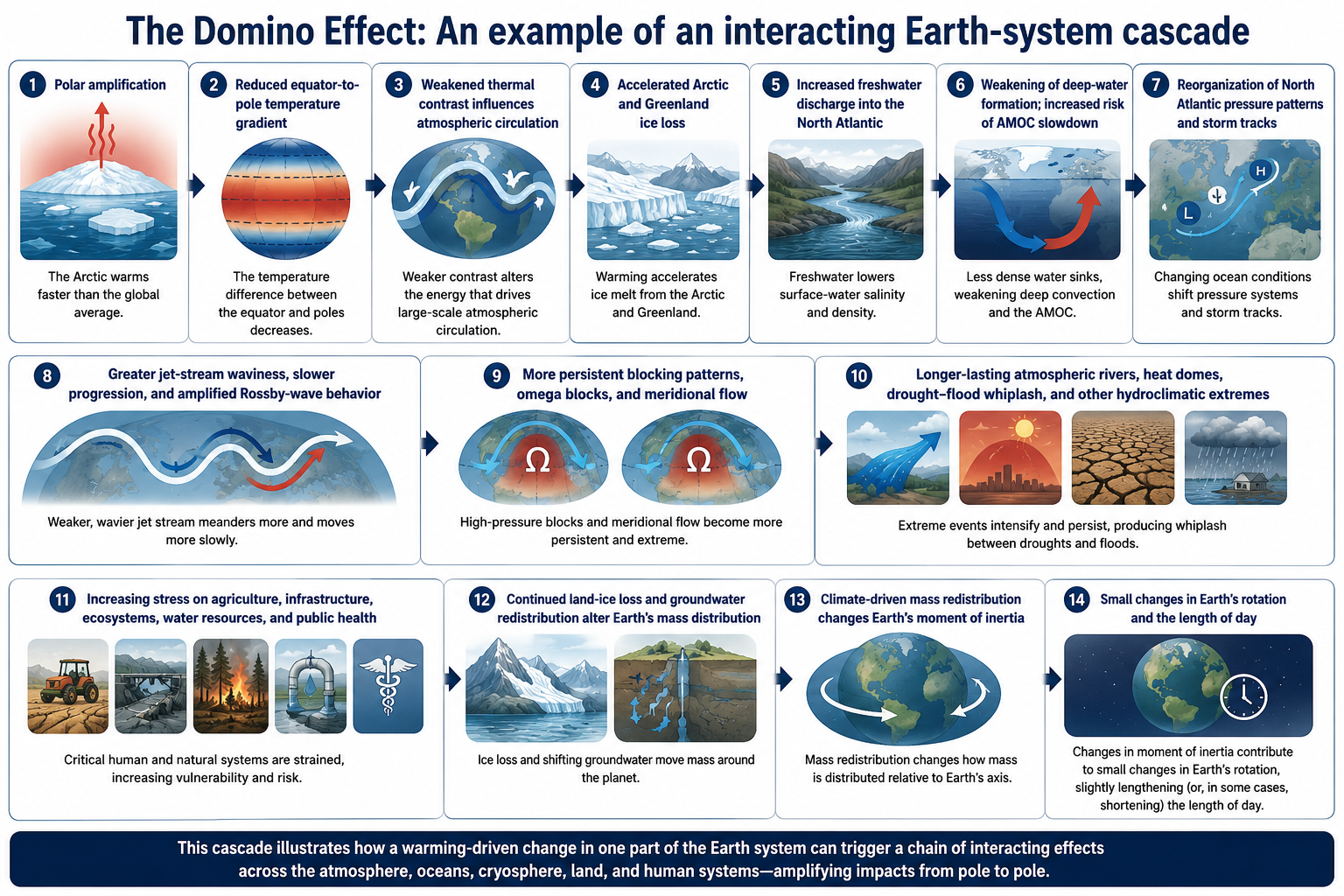
The Domino Effect: An example of an interacting Earth-system cascade
Polar amplification → reduced equator-to-pole temperature gradient → weakened thermal contrast that influences large-scale atmospheric circulation → accelerated Arctic and Greenland ice loss → increased freshwater discharge into the North Atlantic, reducing surface-water salinity and density → weakening of deep-water formation and increasing risk of Atlantic Meridional Overturning Circulation (AMOC) slowdown → reorganization of North Atlantic pressure patterns and storm tracks → greater jet-stream waviness, slower progression, and amplified Rossby-wave behavior → more persistent blocking patterns, omega blocks, and meridional flow → longer-lasting atmospheric rivers, heat domes, drought–flood whiplash, and other hydroclimatic extremes → increasing stress on agriculture, infrastructure, ecosystems, water resources, and public health → continued land-ice loss and groundwater redistribution that alter Earth’s mass distribution → climate-driven mass redistribution sufficient to measurably change Earth’s moment of inertia, contributing to small changes in Earth’s rotation and the length of day.
Abstract
Climate change is no longer characterized solely by gradual increases in global temperature. A growing body of observational evidence demonstrates that multiple components of the Earth system are approaching—or in several cases have entered—states of self-reinforcing change driven by positive climate feedbacks. These nonlinear transitions, known as climate tipping points, increase the likelihood that future warming will proceed more rapidly than would be expected from anthropogenic greenhouse gas emissions alone.
This review synthesizes observational evidence through 2026 regarding the status of the Earth’s principal climate tipping elements, including the Greenland and West Antarctic Ice Sheets, the Atlantic Meridional Overturning Circulation (AMOC), Arctic permafrost, coral reefs, mountain glaciers, boreal forests, and the Amazon rainforest. Rather than functioning independently, these systems interact through atmospheric, oceanic, cryospheric, and carbon-cycle feedbacks that may produce cascading or “domino” effects across the Earth system.
Recent observations—including record ocean heat content, accelerating sea-level rise, unprecedented marine heatwaves, widespread coral bleaching, Arctic amplification, increasing atmospheric moisture, and rapid changes in hydrologic extremes—indicate that Earth is entering a period in which nonlinear feedbacks are becoming increasingly important drivers of climate evolution. Although considerable uncertainty remains regarding the precise thresholds and timing of individual tipping elements, evidence suggests that the probability of interacting tipping cascades increases substantially as global warming approaches and exceeds 1.5–2.0°C above pre-industrial temperatures.
1. Introduction
For decades climate change was commonly portrayed as a gradual, approximately linear response to increasing greenhouse gas concentrations. While this approximation remains useful for estimating long-term average warming, it does not fully describe how complex Earth systems behave near critical thresholds.
Many components of the climate system contain internal positive feedback mechanisms. Once these mechanisms become sufficiently strong, additional external forcing becomes progressively less important as the system begins reinforcing its own evolution.
These threshold transitions are known as climate tipping points.
Unlike gradual climate change, tipping points involve nonlinear behavior in which relatively small additional changes in forcing can trigger disproportionately large and potentially long-lasting responses.
Perhaps more importantly, tipping points do not occur in isolation. They interact through atmospheric circulation, ocean circulation, carbon cycling, and cryospheric processes. The destabilization of one system can reduce the stability of another, producing cascading transitions across the Earth system—a phenomenon often referred to as tipping cascades or the Domino Effect.
2. Climate Feedbacks: The Engine of Acceleration
Every climate tipping point is driven by positive feedback loops.
Examples include:
- Ice-albedo feedback
- Water-vapor amplification
- Permafrost carbon release
- Forest-fire carbon emissions
- Vegetation dieback
- Ocean heat uptake
- Cloud feedbacks
Positive feedbacks increase warming.
Negative feedbacks partially offset warming.
As temperatures rise, positive feedbacks become increasingly dominant within several major Earth systems.
The practical consequence is acceleration.
Instead of climate change progressing at a nearly constant rate, the rate of change itself increases over time.
3. Current Status of Major Climate Tipping Elements
Warm-Water Coral Reefs
Current evidence indicates that tropical coral reefs have become the first major global ecosystem to exhibit widespread tipping behavior.
Mass bleaching events have occurred repeatedly since 2016 and culminated in an unprecedented global bleaching episode during 2023–2025.
Although individual reefs may recover, many reef systems have shifted toward persistent ecological degradation.
Current assessment: Actively tipping
Mountain Glaciers
Mountain glaciers are retreating in nearly every mountain range worldwide.
Many glaciers have already lost sufficient mass that complete disappearance has become unavoidable regardless of future emissions reductions.
Consequences include:
- declining freshwater supplies
- increased hazards from glacial lakes
- long-term contributions to sea-level rise
Current assessment: Long-term loss committed in many regions
Greenland Ice Sheet
The Greenland Ice Sheet continues to lose mass at an accelerating rate.
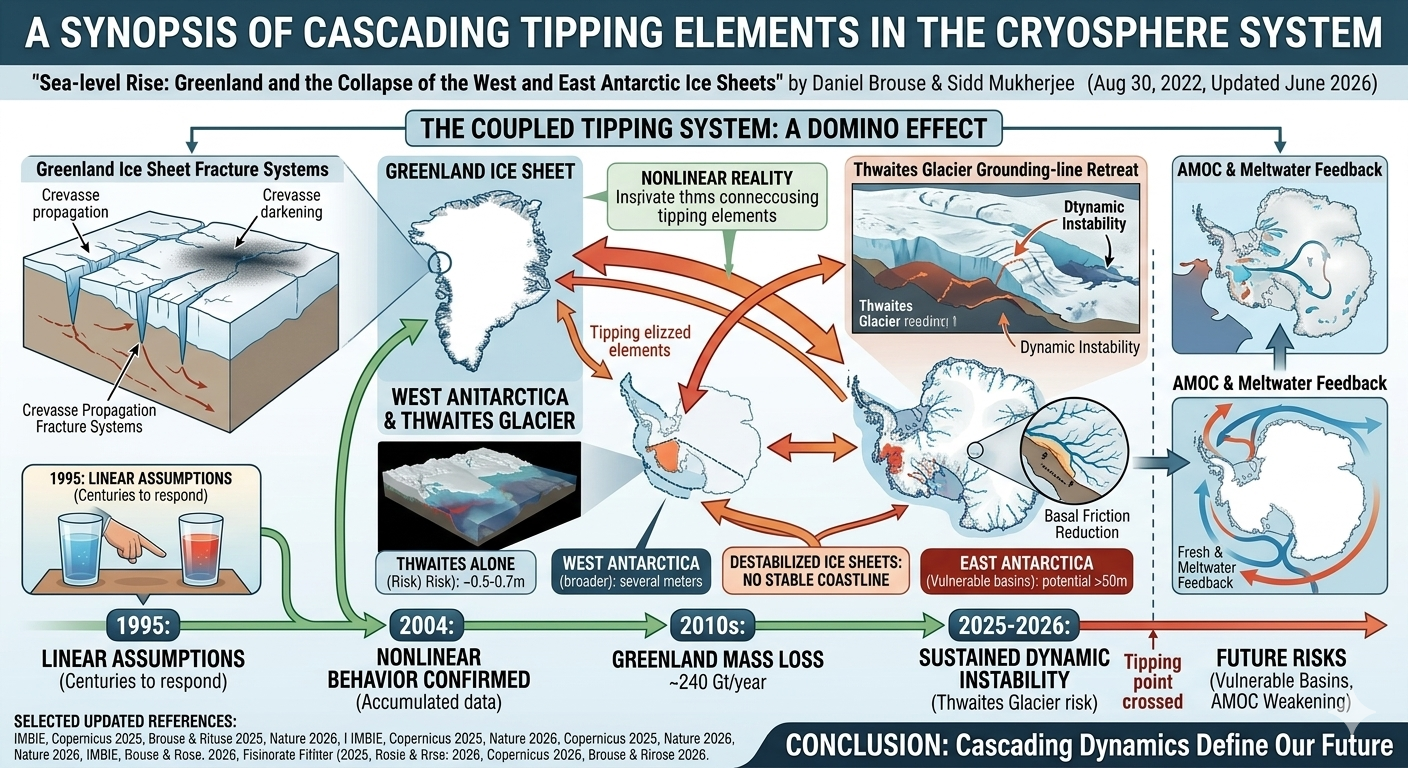
From Linear Assumptions to Nonlinear Reality
In 1995, I was convinced climate change was happening at an exponential rate; however, Sidd argued we needed more data over a longer time period. At the time, the dominant assumption was that global warming was largely linear and slow—offering centuries to respond.
By 2004, enough observational data had accumulated to confirm accelerating nonlinear behavior in the cryosphere and ocean systems. Greenland ice sheet dynamics, in particular, were no longer consistent with equilibrium assumptions.
Much of climate change can potentially be mitigated or slowed. Ice sheet collapse, however, is largely irreversible on human timescales once critical thresholds are crossed.
"And once we have destabilized these ice sheets, there will be no stable coastline for centuries."
Updated Greenland–Antarctica Observations (2025–2026)
Recent observational summaries show:
- Greenland continues long-term net mass loss despite short-term variability
- Antarctica shows regionally mixed signals but sustained West Antarctic decline
- Combined ice sheets have contributed ~2 cm+ of sea-level rise since the early 2000s
- Sea-level rise rate has approximately doubled since the early satellite era
Recent 2026 assessments confirm continued high glacier mass loss globally, with accelerating contributions to sea level rise from both Greenland and Antarctica.
Current assessment: Actively destabilizing
Example: Greenland and Antarctic Ice Sheet
West Antarctic Ice Sheet
Marine ice-sheet instability is progressing in several sectors of West Antarctica, particularly near Thwaites and Pine Island glaciers.
Ocean warming beneath floating ice shelves continues to reduce buttressing, increasing ice discharge into the Southern Ocean.
Although complete collapse remains uncertain in timing, several marine basins now appear vulnerable to irreversible retreat.
Current assessment: High confidence of ongoing destabilization
Arctic Permafrost
Abrupt thaw, thermokarst formation, methane emissions, and increasing wildfire activity are altering large portions of Arctic permafrost.
These changes reduce one of Earth’s largest terrestrial carbon reservoirs while increasing greenhouse gas emissions.
Current assessment: High risk
Atlantic Meridional Overturning Circulation (AMOC)
The AMOC has weakened substantially over the past century.
Freshwater from Greenland melt, increased precipitation, and Arctic warming continue to reduce North Atlantic surface-water density.
While the timing of any future collapse remains uncertain, observations indicate that resilience has declined.
Current assessment: Weakening with elevated tipping risk
Amazon Rainforest
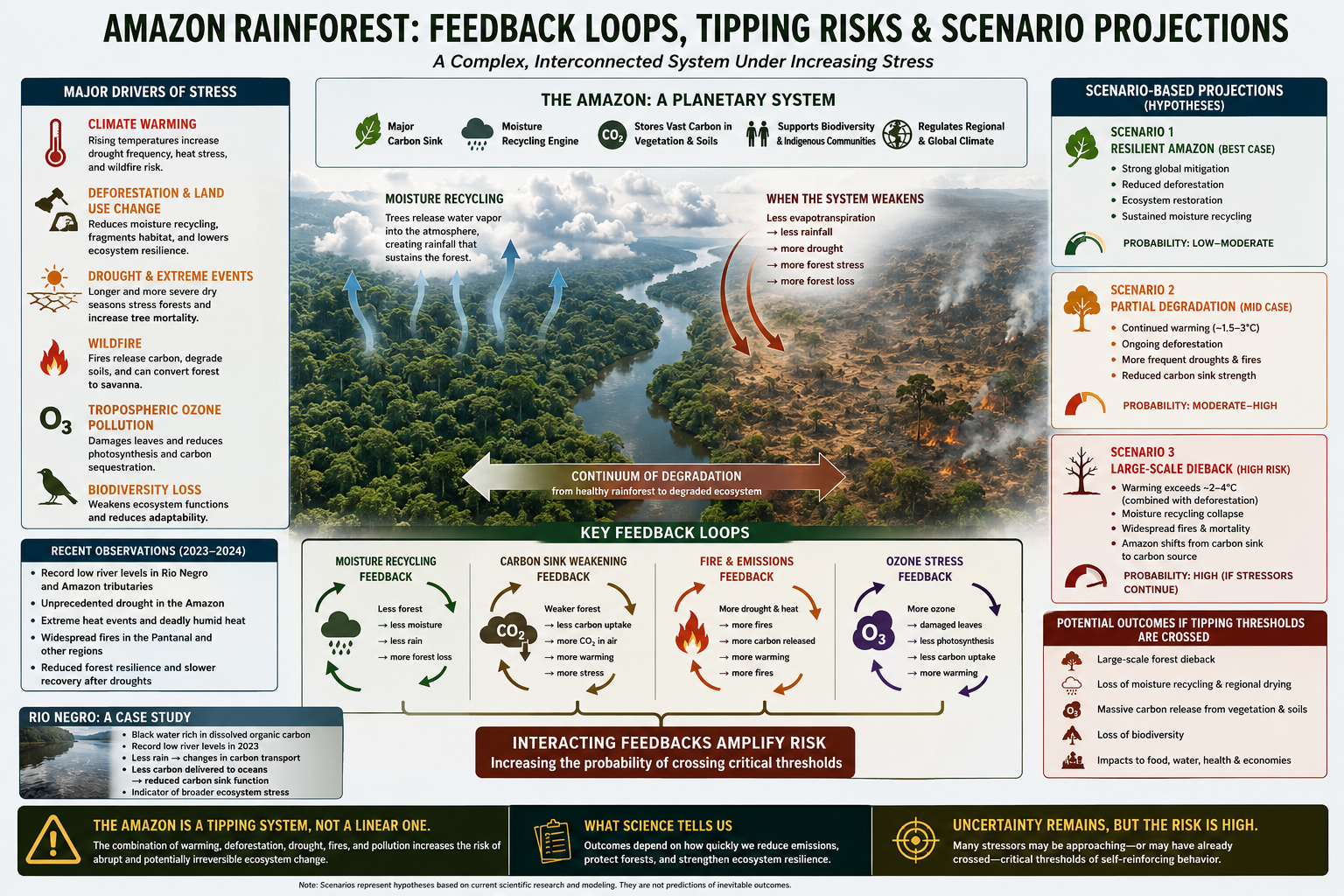
The Amazon faces simultaneous stress from warming, drought, wildfire, and deforestation. Southern portions of the basin have already shifted from net carbon sink toward seasonal carbon source. Large-scale forest dieback would reduce rainfall recycling and amplify regional drying.
Several scenario-based projections suggest that continued warming, ongoing deforestation, and additional environmental stressors could increase the probability of large-scale forest degradation during the coming decades. While significant uncertainties remain regarding specific thresholds and outcomes, there is increasing concern that some underlying stressors may be approaching—or in certain cases may have already crossed—critical tipping points beyond which system responses become increasingly difficult to predict, manage, or reverse. The central scientific challenge is therefore not simply determining whether such thresholds exist, but identifying where they lie, how rapidly they are being approached, and how interacting feedbacks may amplify risks across interconnected systems.
Current assessment: Fragmenting under combined climate and land-use pressures
Example: Amazon Rainforest Dieback
Boreal Forests
Increasing wildfire activity, insect outbreaks, and drought are transforming boreal ecosystems across Canada, Alaska, and Siberia.
These forests are migrating northward while losing biomass across their southern margins.
Current assessment: Increasing ecological stress
4. Interacting Climate Cascades
The greatest concern is not any single tipping point.
It is their interaction.
The Greenland Ice Sheet provides a clear example.
Accelerated melting introduces freshwater into the North Atlantic → Freshwater weakens deep-water formation → AMOC slows → Ocean heat redistributes toward the Southern Hemisphere → Additional heat reaches West Antarctica → Ice-sheet instability increases → Sea-level rise accelerates
Meanwhile:
AMOC weakening alters atmospheric circulation → South American rainfall decreases → Amazon drought intensifies → Forest dieback increases → Carbon emissions rise → Global warming accelerates
This sequence illustrates how apparently separate climate systems become mechanically coupled.
5. Emerging Indicators of Nonlinear Climate Change (2025–2026)
Several observational indicators suggest acceleration is occurring across multiple components of the climate system.
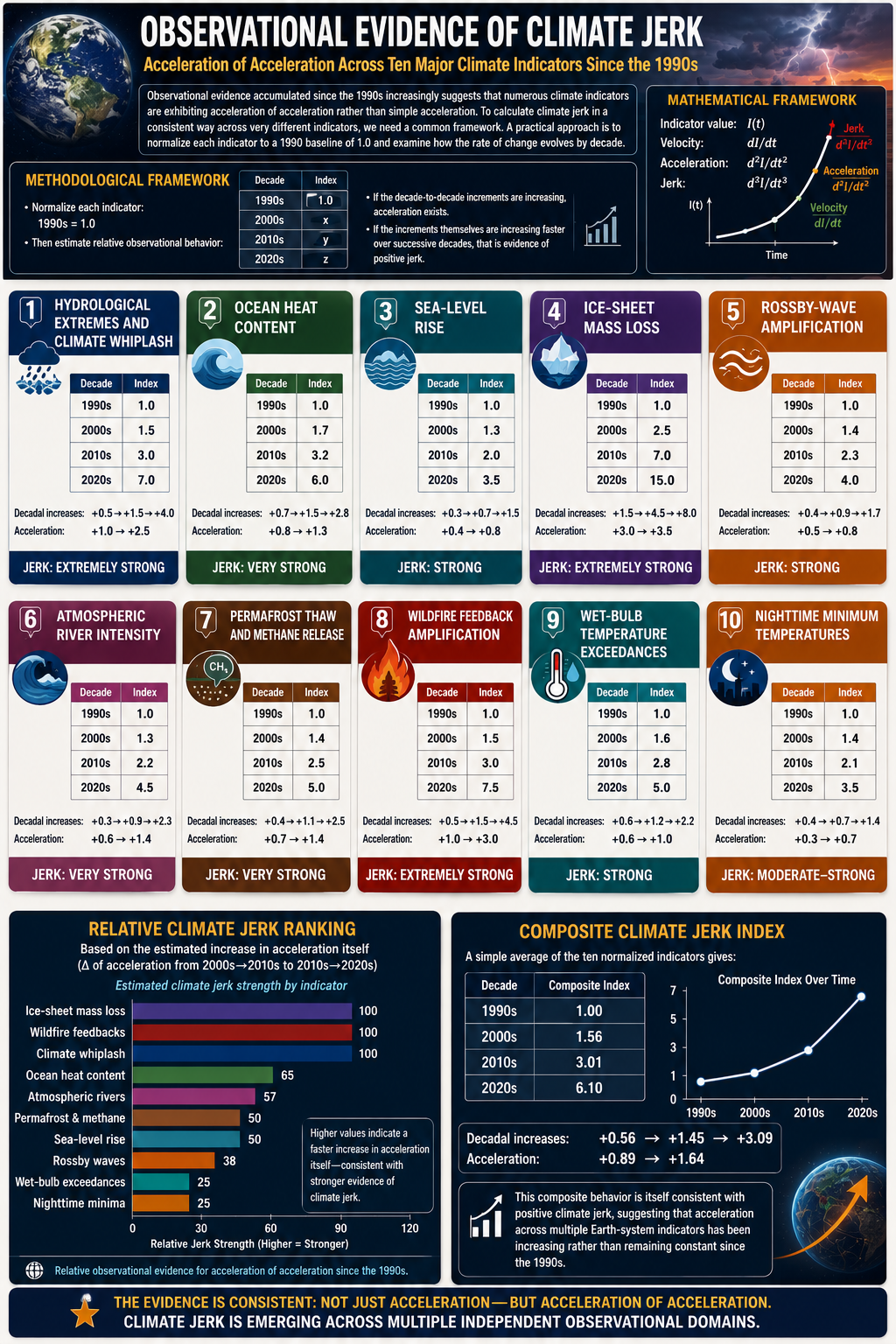
Among the strongest indicators are:
- Record global ocean heat content
- Increasing Earth energy imbalance
- Accelerating marine heatwaves
- Increasing atmospheric moisture
- Stronger atmospheric rivers
- More persistent Rossby-wave blocking
- Arctic amplification
- Accelerating sea-level rise
- Longer wildfire seasons
- More rapid permafrost thaw
- Increasing nighttime temperatures
- Greater frequency of compound drought–flood events
Individually these indicators do not prove tipping cascades.
Collectively they demonstrate increasing instability throughout the climate system.
6. The Domino Effect
Climate tipping points should not be viewed as isolated thresholds.
They function as an interconnected network.
Positive feedbacks reinforce warming.
Warming destabilizes tipping elements.
Destabilized tipping elements activate additional feedbacks.
Those additional feedbacks increase warming further.
The process repeats.
This cascading behavior compresses climate timescales.
Processes once expected over centuries may increasingly unfold over decades in vulnerable regions.
Although considerable uncertainty remains regarding the exact timing of future transitions, the probability of interacting tipping cascades increases as warming continues.
The Domino Effect: An example of an interacting Earth-system cascade
Polar amplification → reduced equator-to-pole temperature gradient → weakened thermal contrast that influences large-scale atmospheric circulation → accelerated Arctic and Greenland ice loss → increased freshwater discharge into the North Atlantic, reducing surface-water salinity and density → weakening of deep-water formation and increasing risk of Atlantic Meridional Overturning Circulation (AMOC) slowdown → reorganization of North Atlantic pressure patterns and storm tracks → greater jet-stream waviness, slower progression, and amplified Rossby-wave behavior → more persistent blocking patterns, omega blocks, and meridional flow → longer-lasting atmospheric rivers, heat domes, drought–flood whiplash, and other hydroclimatic extremes → increasing stress on agriculture, infrastructure, ecosystems, water resources, and public health → continued land-ice loss and groundwater redistribution that alter Earth’s mass distribution → climate-driven mass redistribution sufficient to measurably change Earth’s moment of inertia, contributing to small changes in Earth’s rotation and the length of day.
7. Scientific Uncertainty
Significant uncertainties remain.
Researchers continue to debate:
- precise temperature thresholds
- rates of future ice-sheet response
- methane release from permafrost
- resilience of tropical forests
- future behavior of the AMOC
- interactions among multiple tipping elements
These uncertainties should not be interpreted as evidence that tipping points are absent.
Rather, they reflect the complexity of coupled nonlinear Earth systems.
The direction of change is well established.
The exact timing remains uncertain.
8. Conclusions
Observations through 2026 indicate that Earth is entering a period in which nonlinear climate feedbacks are becoming increasingly important.
Several climate systems—including warm-water coral reefs, mountain glaciers, portions of the Greenland Ice Sheet, Arctic permafrost, and sectors of the West Antarctic Ice Sheet—are exhibiting sustained changes consistent with increasing instability.
Other systems, including the AMOC and Amazon rainforest, remain highly vulnerable as global temperatures continue to rise.
The principal scientific challenge is no longer identifying individual tipping points. It is understanding how they interact.
The emerging evidence suggests that the Earth’s major climate systems function less like isolated components than as an interconnected network linked by feedback loops, energy flows, and atmospheric and oceanic circulation.
Whether future climate change remains relatively manageable or evolves into a series of cascading transitions will depend largely on the magnitude and duration of future warming.
While some long-term changes may already be committed because of internal feedbacks, rapid reductions in greenhouse gas emissions can still substantially reduce the likelihood, speed, and severity of additional tipping cascades.
The coming decades will determine not only how much the planet warms, but whether multiple Earth-system tipping elements remain largely independent or become synchronized into a self-reinforcing global transition.
The Domino Effect
Warming → Feedback Activation → Feedback Coupling → Amplification → Tipping-Point Threshold → Cascade
The climate system is not simply warming—it is changing how it responds to that warming. Coupled climate feedbacks are becoming one of the most consequential dimensions of climate risk in the 21st century because they amplify changes and connect individual tipping-point pathways into larger cascading effects.
The longer warming persists, the more climate feedbacks become active. As these feedbacks interact, we are already observing nonlinear responses, amplification, and cascading impacts across the climate system. Hundreds of feedback mechanisms have been identified, and many can couple and reinforce one another, contributing to the accelerating pace and increasing magnitude of climate change—The Domino Effect.
Sources and Resources
Foundational Domino Effect Research- Observational Evidence for Climate Jerk: Multidisciplinary Indicators of Accelerating Climate Acceleration
- The Acceleration of U.S. Climate-Linked Economic Burden (1890–2040 Projection)
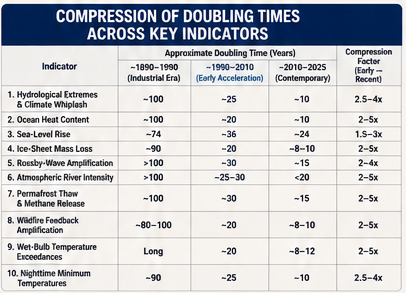
- The Compression of Doubling Times Across Earth-System Indicators: Evidence for Increasing Nonlinearity in the Climate System
- Observational Evidence of Climate Jerk
- Beyond Average Warming: Temperature Extremes, Nighttime Heat, and the Emergence of Climate Jerk
- Calculating the Rate of Climate Acceleration in a Nonlinear Earth System
- Jerk-Behavior in Earth’s Rotation: Climate Change, the Third Derivative, and Emerging Risks to Precision Navigation
- A Unified Energetics Framework for Accelerating Climate Change: From Radiative Forcing to Drag Physics
- Singularity: Public Access Version (6th-grade level)
- Singularity: Easy Version (~8th–10th grade level)
- Singularity: Journal-Ready Version (~college graduate level)
* Our probabilistic, ensemble-based climate model — which incorporates complex socio-economic and ecological feedback loops within a dynamic, nonlinear system — projects that global temperatures are becoming unsustainable this century. This far exceeds earlier estimates of a 4°C rise over the next thousand years, highlighting a dramatic acceleration in global warming. We are now entering a phase of compound, cascading collapse, where climate, ecological, and societal systems destabilize through interlinked, self-reinforcing feedback loops.
We examine how human activities — such as deforestation, fossil fuel combustion, mass consumption, industrial agriculture, and land development — interact with ecological processes like thermal energy redistribution, carbon cycling, hydrological flow, biodiversity loss, and the spread of disease vectors. These interactions do not follow linear cause-and-effect patterns. Instead, they form complex, self-reinforcing feedback loops that can trigger rapid, system-wide transformations — often abruptly and without warning. Grasping these dynamics is crucial for accurately assessing global risks and developing effective strategies for long-term survival.
Feedback Loops → Tipping Points → Feedback Loop and Tipping-Point Network → Acceleration → Domino Effect
Feedback loops amplify climate change and can push interconnected Earth systems past critical tipping points. As tipping points are crossed, they can trigger additional feedback loops and destabilize other climate systems. This cascading "Domino Effect" compresses timescales, accelerates change, and increases the risk of rapid, nonlinear climate transformations.